|
Yarrow, British Columbia
Edited by
Esther Epp Harder, Edwin Lenzmann, and Elmer Wiens
Yarrow's Settlers: 1946-1955
1946 | 1947 | 1948 | 1949 | Yarrow Softball
| 1950 | 1951 | 1952 | 1953 | 1954
| 1955
Cornelius Funk | Reimer's Nursery |
Yarrow Athletic Association | Henry Goossen
| It Was A Time
|
Downtown Yarrow circa 1948

From right to left on the north side (our pov): Betty Mengies' Bright Spot (behind the pole), Froese's Meat Market, Funk's Grocery, AbeErna's Grocery(wide awning),
and a Dry Goods etc. store, also probably owned by Abe and Erna Ewert.
Kehler Street was occupied by Jacob Froese's house set back from Central Road and orchard. East of the pole is the H.P. Neufeldt house and the defunct Reisen blacksmith shop.
The row of houses at the top of the picture are located on what are now called Community Street and Knox Avenue.
Photo is probably circa 1948 since there are no sidewalks on either side of Central Road, which appears to be surfaced with gravel.
In the morning, children attending the Yarrow School from east of the B.C. Electric train tracks were dropped off at the school bus stop in front and slightly to the west of the Neufeldt house.
In the afternoon, Chilliwack High School students were dropped off here. Children living west of Yarrow along Dyck and Boundary Roads were picked up there after school. There was a bus stop
across Central Road on the northwest corner of the school grounds where children from Dyck and Boundary Roads were dropped off in the morning, while Chilliwack High School students
were picked up. Children living east of the train tracks were picked up here in the afternoon.
|
|
Yarrow Growers' Co-operative Association (Co-op)

In 1943, the Yarrow Growers Association, formed in 1936 to market member farmers' produce, amalgamated with the Yarrow Growers Co-operative Association, formed in 1937 to sell consumer goods to members. The Yarrow Co-op operated successfully during the years of WWII, selling most of its processed berries to the Canadian Government for shipment to Great Britain. Along with its large processing plant at the end of Eckert Road, the Co-op ran a two-story department store at the corner of Eckert and Central Roads, with shoe, clothing, "yard cloth," hardware, and grocery departments. This modern building also contained a coffee shop and the Co-op's offices. William Schellenberg was the President; Jacob Krause was the General Manager; and Peter Friesen was the Bookkeeper (Klassen 75-78).
When the Canadian Government stopped buying berries to ship to Great Britain, the Co-op could not market its members' berries, leading to the liquidation of the Yarrow Growers' Co-operative Association in 1949.
The following article by Jacob Krause analyzes the prospects for Yarrow's berry industry following WWII.
|
— — — Der Friedens-Bote: September 1946 pages 3-4 — — —
Der Friedens-Bote was a community paper, put together and published
in the 1940's by Kornelius Neufeld of Columbia Press, Yarrow, B.C.
|
|---|
|
Do Berries Have a Future
by Jacob C. Krause, Co-op General Manger
It is completely correct when we ask ourselves if it still is worth it to plant more raspberries or strawberries. Stimulated by the good berry prices which have already held for several years, more and larger areas are being planted with berry bushes. Several years ago this expansion was done more cautiously. People enlarged their raspberry patch by planting a few more rows, or they spoke of planting a quarter or a half acre. Today it is completely natural to speak of planting several acres of berries. Small dairy farms are being converted to berry farms. And it doesn't surprise anyone, that with today's existing prices, a berry farm brings in a lot more money than any other line of farming. How the production of berries in our organization here in Yarrow grew is shown by the following figures, measured in tons. [2000 lbs. = 1 Ton] 1937 - 37; 1938 - 70; 1939 - 116; 1940 - 167; 1941 - 204; 1942 - 300; 1943 - 416; 1944 - 814; 1945 - 1350; and 1946 - 2000.
I don't have completely accurate data as to when the berry fields were planted, but according to the data we do have, as of this year, Yarrow has approximately 350 acres in raspberries. After a further appraisal, more than 200 acres of raspberries have been added this year. In other areas, raspberry acreage is increasing at the same rates.
As long as market conditions stay as they are today, everything will be good. The export market swallows up the largest part of our harvest and the rest of the market is divided here in Canada. This year, for example, we could have sold many more berries.
However when we take into account the growth in the berry acreage as outlined above and then look into the future, we would do well to move ahead with more planning. Each farmer would have to be more aware of the complete raspberry situation so that we don't make mistakes which we could have avoided.
It has also shown itself, that we in the Fraser Valley have very favourable climate and soil conditions for raspberries. The yield results are 5-8 and more tons per acre. We could call this Berry Land, just as there are Sugar Beet Lands, Vegetable Lands, and Watermelon Lands etc. At first glance, such a harvest seems large and everyone is asking who in all the world buys all the berries; and what will be come of it, if every year more and more berries are produced.
There is only one answer and solution. The whole berry production must be watched carefully and the sales must be in an organized, wise/prudent, controlled way. Steps must be taken to manage and fight the results of the raspberry cane disease in the right way; and also comply, to help stop the spread of very tiny worms in the berries through applications of the remedies that have been determined to prevent their spread. It should be our goal to have only first class products to bring to the markets. To advance the right way in this respect, all areas [that grow raspberries] should get together and establish an experimental station. Here the various applications could be tested, and new varieties of raspberries could be tried. Testing of fertilizers and manure applications in practical trials, as well as, to conduct other trials to help and be able to give advice to farmers.
Let us suppose, that in two years, BC would have approximately 10,000 Tons of berries to sell and one organization would underbid the other in the prices. How quickly would the buyers make good use of this situation, and oh dear, how disappointed would the farmer be then? Or, let us assume, for example, that the "Crate shipping" to the Prairies should get out of control. It would be a fiasco, so that all the berries would be bitter and sour to all of us. When we were in the Okanagan at the beginning of this year to get information in relation to this, an experienced official of the large fruit syndicate there, told us of the experiences they had had. It had come so far that a box apples didn't pay enough for a picker to pick the apples. All the farmers had to bear the total loss of their crop because of this. However, this was a lesson, an expensive lesson, and it woke them up and sobered all of them. Since then the apple production is flourishing and every farmer is happy with his apple tree(s). We want to learn from the mistakes of others. It is good when each farmer knows that he must contribute, so that we can pursue our berry farming in an orderly manner. Everything will be sold only through our organization. If a private buyer comes to a farmer, who perhaps offers a "better price" or promises , "cash", people with such good news should confidently be sent our office, where we would gladly close a good deal with them. So, always be cautious with such people who offer enticing prices who want to hurt our organization, their goal is to make a profit for themselves. We should be giving particular warnings about these signs, because we certainly must assume, that the more we [farmers] unite to protect ourselves, the more brazen the attacks from the outside will become. Each member should respect the authority of his organization much more and try with his best efforts to follow the respective instructions.
In order that the various small villages in marketing [of berries], not work against one another and perhaps even engage in competition, it is absolutely necessary, that we now need to have a representative sales agency. In this agency, each organization has their own representative, so that the interests all partners will be guaranteed in the same way. In this way it will also be possible for us to receive a more stable price for our berries.
We also don't know, if it will be possible for us to sell the larger bulk of our berries in barrels in the future. Suppose we assume the possibility that inquiries for S02 berries could have a strong decline. Against this possibility, the berries should be preserved in another form, perhaps by canning, as jam or by freezing; if we were asked for this today, they would find us completely unprepared. We would accuse ourselves, that we had not been watchful enough. It is no illusion, if today we tell ourselves, that united we could have an extensive berry production, where a large part of our harvest is filled into cans and frozen in boxes. If we take today's berry prices into consideration, there will hardly be a better opportunity for us to contribute a small part from our good income this year to secure future markets for our berries. And, the sooner we turn this idea into reality, the better. Unity makes us strong.
It would be of great interest to know, what people in the various small villages think about this [berry] business. Please put your thoughts on paper and send them to the writer of these lines.
|
1946
|
Yarrow News From The Chilliwack Progress For 1946
|
|---|
| The Chilliwack Progress, June 26, 1946 |
|
COUNCIL TO COMPLETE YARROW SPAN
Engineers Estimate Cost At $8000
Completion of the new bridge across the Vedder River at the RCSME bridging area, started some time ago by the Engineers, will be the responsibility of the Township,
it was revealed in a letter to township council Saturday from Col. C.N. Mitchell, VC, MC, officer commanding the camp.
Col. Mitchell's estimate of the cost of decking and other material is in the neighborhood of $8000. In addition there will be provision of a fill approach from the south end.
Military requirements are that, the right-of-way to the bridge through camp property be fenced, with four gates provided. Trespassing on military property "will not be tolerated,"
it was stated in the communications. Penalty is removal of center span from the bridge. Col. Mitchell offered to give all possible assistance in the work of putting the deck on
the structure.
The new bridge when completed will provided a shorter route to Chilliwack and all points east of the Vedder canal for the growing reclaimed Sumas area; including Yarrow and will
divert much traffic from the winding Vedder Mountain road to Yarrow. The bridge is located at the end of Sumas Prairie Road on the north side and connects with Wilson Road
at the south side.
Council unanimously decided to proceed with the completion of the bridge as soon as possible. The center span provides for one-way traffic only, but will not seriously interfere
with use of the structure in the opinion of council.
Reeve Richardson will inspect and pass upon work of covering garbage dump at Watson Road gravel pit done by Frank J. Mitchell, the new owner of the property.
The 20-mile speed limit bylaw on Yarrow Central Road and intersecting roads, received finally reading.
Application by R.H. Clarke for gazetting of 1200 feet of dyke between Brinks Road and his property, as a road, was referred to Councillor Bathgate.
Red Cross will be advised to remove to headquarters a quantity of disaster relief supplies, now stored in the Masonic Hall. City and Township councils pay a rental charge of
$5 a month for storage.
A platform and shelter has been erected at Stewart road on the Fraser Valley line of the B.C. Electric, at request of residents adjacent thereto, and the "stop" at Sinclair Road
has been discontinued, the railway company advised by letter.
Councillors Ryder and Bathgate, together with Clerk Brice, were appointed to prepare a brief on dyking capital charge and maintenance, for presentation of Commissioner Dean F.M.
Clement here July 10. If within the scope of the Commissioner's inquiry, township will lay their case for a larger contribution by the city toward dyke and riverbank protection costs.
No action was taken on an application by Harold Gallagher to establish bus routes throughout the township, pending a meeting with city council to discuss the feasibility of the two
corporations going into the transportation business jointly.
Messrs. Keller, Epp and Reimer petitioned for inclusion of Sumas Prairie Road from the Trans-Canada Highway to South Sumas Road. Sumas Prairie School is located in this stretch
and the delegation pointed out the duct on this road was a great danger to traffic and to children. Council inspected the road following adjournment.
L.C. Rogers requested opening the half mile long Parker Road in East Chilliwack district. Council will meet Mr. Rogers on the site at a time to be arranged.
A petition was received requesting that Ford Street was received requesting that Ford Street, Sardis be oiled or surfaced. The street leads to the RCSME supply depot from
Vedder Road.
|
| The Chilliwack Progress, October 16, 1946 |
|
Yarrow to Approach Council
Will Ask Approval Of Sidewalk Plan
Yarrow will press for municipal approval of a $6500 sidewalk scheme at the next council meeting; it was decided at a meeting of the Yarrow Waterworks board.
Councillor John Martens will present the plan which calls for construction of a maximum of five miles of paved sidewalks.
The council will be asked to handle the work under improvements, advancing money for the work now and levying it later against tax assessment.
The sidewalks would extend along Yarrow Central road and such other side roads as could be handled under the five-mile maximum.
The meeting also endorsed a proposal to ask council approval for installation of street lights in as many parts of Yarrow as possible. (Lighting of Yarrow Central for a distance of a mile has already been approved.
Yarrow Water board, with 300 subscribers represents a majority of Yarrow residents and is taking the lead in pressing for a completion of the scheme by virtue of a majority vote. Next community work the organization will handle will be the installation of 26 fire hydrants, six of which have already been installed and erection of street names and speed limit signs.
The board consists of five trustees, headed by Chairman H.G. Sukkau and Secretary J.J. Wittenberg.
|
| The Chilliwack Progress, November 14, 1946 |
|
Outlines Township Paving Plan
Details of the 19 mile hard surfacing program to be submitted to township ratepayers at the December elections reveal that the plan will bring some hard surfacing to almost every district.
The program also calls for extension of hard surfacing done this year.
Largest single stretch on one road is 2.4 miles of hard surfacing for the South Sumas Road between Vedder and Lickman roads.
The following is the detailed program:
School Road Sardis, Vedder to Higginson Rd. - .7;
School to Chilliwack River rd. .5;
River Road; Higginson Road to Bailey Rd. - .5-1.7.
Wells subdivision, 1st Ave to Evans Rd. .7; Evans Rd.,
Wells Rd to Trans-Canada Highway .6 -1.3.
Hocking Avenue, Trans-Canada Hwy to Young Rd. - .3
Reeves Road, Trans-Canada Hwy to Camp Slough Rd. 1.3;
Camp Slough, Reeves Rd. to Jespersen Rd.- .2-1.5.
McDonald Rd., Hope Slough to Bell Rd. .6 -.6
McSween Rd, Hope Slough to Wells Rd. - 1.
Big Ditch Road, Trans-Canada Hwy to Chilliwack Central - 1.1.
Prairie Central, River Road to Banford Rd. - 2.2.
First Avenue, City Limits to Prest Road - 1.3.
Lickman Rd., Trans-Canada Highway to South Sumas Rd. - 1.9.
South Sumas Road, Vedder Road to Lickman Rd. 2.4.
Sumas Prairie Road, Trans-Canada Highway to surfacing .2;
Keith Wilson Rd. to surfacing 1.0-1.2.
Eckert Road, Yarrow Central to B.C. Electric Railway .7.
Yarrow Central Rd surfacing to Boundary Road -.4
Yarrow Dyke Road, Yarrow Central Road to Boundary Rd. 1.3.
Total - 18.9
|
1947
|
Yarrow News From The Chilliwack Progress For 1947
|
|---|
| The Chilliwack Progress, January 29, 1947 |
|
Turnover of More Than a Million
Co-op Is Yarrow's - Largest Enterprise
Largest commercial enterprise in Yarrow is the Yarrow Growers' Co-operative Union, which represents 4,000 farmers in the area and last year had a turnover of well over a million dollars.
Two co-operatives combined in 1943 to form the concern, which has shown the same amazing growth as the community in general.
The original group was known as Yarrow Co-operative Association and was formed in 1935 with a membership of 30. This co-op handled a retail store but no produce.
In 1937 the Yarrow Growers Co-operative was formed for the express purpose of marketing fruit.
Raspberries form the largest volume of business handled by the co-op. It was mostly for the handling and processing of this tremendous crop that a $40,000 processing plant was built in 1945.
Increase of poultry farming in the area was also noted in the same year with the addition of an egg grading department, and last year a plant to kill and dress poultry was established.
Another milestone in the expansion of the co-op will be marked by the opening of its department store sometime before May 1.
The $50,000 two-storey structure, which dominates the center of Yarrow's business section, will offer for sale groceries, meat, dry goods, feed and furniture.
The building will also house the offices of the Bank of Commerce. The top floor will be occupied by Co-op offices.
NEW BUS LINE WILL SERVICE THRIVING CENTRE OF YARROW
Furnishing bus service to the 2500 residents of the Yarrow area will be one of the most important contributions offered to Chilliwack valley by the new border run of Atkins Stage Lines.
The phenomenal growth of Yarrow is a record of hard work in a new country by people of the Mennonite faith who immigrated to this country from Russia.
Twenty years ago there was no trace of the bustling community of today. Only one store, owned by W. Siddall, was operating at that time.
In 1928 the vanguard of the Mennonite settlers arrived. Ten families were in the first party and most of them settled in the immediate vicinity of the present village.
As more families appeared, the settlement spread, and farm land was taken up along the narrow strip between the Vedder River and the mountains, and south on Sumas flats.
The village of Yarrow remained the center of the district though and in 1930 the first store built by one of the settlers was opened. It was a typical rural general store and was owned by John Derksen until his retirement seven years ago.
From this modest beginning, the business section of Yarrow has grown steadily, and now there are 23 stores and small businesses along Yarrow Central Road.
Civic pride is manifest in the smart appearance of the Yarrow shops, which are concentrated at either end of a mile-stretch of the highway. The paving of Yarrow Central (road) last year has helped the appearance of the business section.
Waterworks Board
Community endeavor is shown at its best in the ambitious plans of the Yarrow Waterworks Board.
The board was formed in 1944 to provide a water system. Original reservoir and pipe line cost $35,000 and the system was set up in record time. There are now seven miles of pipe supplying water to district subscribers.
The board has not confined itself to supplying water however. At every meeting, problems of civic improvement are discussed. Fire hydrants and street signs are the next job facing the board, and it was this group that originated a request to township for money to carry on the laying of five miles of sidewalks.
Berry Growing Popular
Principal industry of the area is agriculture. Most of the farmers are berry growers and raspberries form the bulk of the crops. Within the last year, however, there has also been a marked increase in poultry farms.
Dairy farming is losing ground in the district with the breaking up of large farms into smaller lots. This also explains the prevalence of berry growers and poultrymen who can earn a living with smaller acreage.
New Atkins Bus Line Marks Important Step in Area Transportation
The opening of the Harrison-Chilliwack-Huntingdon bus route of Atkins Stage Lines will mark an important milestone in the history of district transportation.
With the addition of this run the local company's sprawling routes will cover 83 miles of road between Harrison and the border.
Two transportation "firsts" will be inaugurated with the new system.
For the first time, American tourists will have a direct bus route from Bellingham to Harrison. The Satterlee bus system from Bellingham will connect with Atkins' bus.
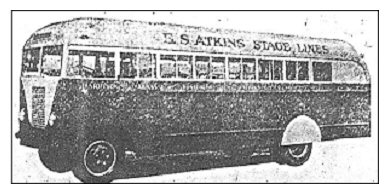 To the 2500 residents of Yarrow district, the new line brings bus service that will provide connections to all parts of the Fraser Valley and the coast.
From Yarrow, travellers will be able to make connections with Vancouver buses at either Barrowtown or Chilliwack and with the cross valley system at Huntingdon. The later line serves Abbotsford, Mission and Haney.
Growth of the Company
The steady growth of Atkins Stage Lines since the company was formed eight years ago can be directly attributed to the untiring efforts of one man, Eric Atkins.
 In 1939, Mr. Atkins head of Woodward's garage in Vancouver, took over the entire assets of the Harrison Lake Transportation company, consisting of a franchise to operate a bus line between Harrison and Cultus Lake, and one antiquated bus.
To keep the line going, the new owner took over the dual role of bus driver and mechanic. Days were spent on the road and at night Mr. Atkins would look after the mechanical repairs, often just managing to catch a couple of hours of sleep on the back seat of the bus before starting on the morning run.
As the company started to make money, new equipment was added and drivers hired, but it was not until the spring of 1946 that the company branched out into new routes.
Ryder Lake First
The Ryder Lake run was the first step in expanding the line bringing bus service to the residents of that area for the first time.
In the fall of the same year (1946) a Chilliwack-Evans Road run was started, servicing Sardis, and several runs of the Harrison-Cultus Lake route were re-directed to service East Chilliwack.
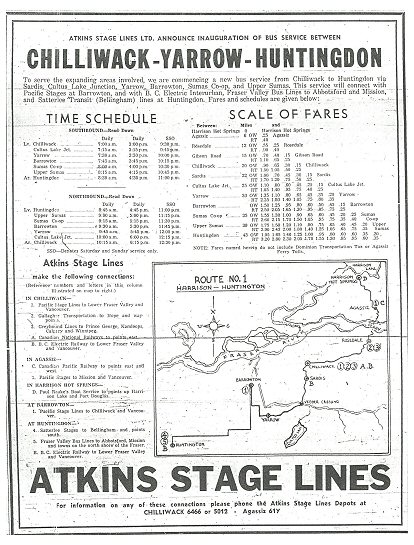 From a one-man, one-bus company in 1939, Atkins Stage Lines has grown to a point where it now employs 10 drivers, four mechanics, a dispatcher and an office staff of four.
Rolling stock consists of seven busses, one eight-passenger car, an express truck and a wrecker. A new 45 passenger bus will be added to the fleet soon to handle the southern route.
Next step in expanding the company's lines will be an extension of the Evans road route. This is scheduled to take place in the spring and will service South Sumas, Blackburn and Keith Wilson roads.
Perhaps no other business in the city has encountered the same difficulties in endeavoring to expand than Atkins Stage Lines.
With the establishment of RCSME at Vedder Crossing, rival companies tried unsuccessfully to acquire the franchise for this lucrative traffic.
Establishment of the line to Huntingdon was balked once in 1939 by the BC Electric railway and last month when application was again entered with the Public Utilities Commission, Pacific Stage Lines contested the action.
The local company has successfully weathered these difficulties however, and remains firmly entrenched in the district transportation picture.
71 Sportsmen Join Group
Yarrow Athletic Club Plans to Build Hall
Athletic activities are coming into prominence in Yarrow. The latest development along these lines is the formation of an athletic association by 71 young sportsmen of the district.
In the process of being registered at Victoria, the club which was formed in December will be known as the Yarrow Athletic-Entertainment Association, and the first endeavour to be undertaken is the building of a gymnasium, 60 by 80 feet.
Supplying the labour themselves, the members estimate it will take $3800 to build the shell of the hall and lay a hardwood floor.
The $3800 will be raised mostly by assessing each member $50 for shares payable at the rate of $5 a month.
To help defray the rest of the cost, club president John Hepting is operating his own film projector at club-sponsored shows.
The members hope to have their hall completed by next winter and will operate it as a roller skating rink to raise additional fund to buy equipment, finish the hall and keep an athletic park going.
Pending formal registration of the club, the temporary executive includes W.W. Siddall, vice-president; Henry Froese, secretary; and Fred Hendricks, treasurer.
Site of the proposed hall is not definite, but it will probably be on Boundary road, about a mile out of Yarrow. Four acres of ground will be acquired for the athletic park.
|
| Advertisements from Yarrow |
|---|
|
|
|
The Chilliwack Progress, Feb 5th, 1947
|
|---|
|
Five Co-operatives Join Market Agency
Fruit Growers Form Central Sales Group
The first co-operative sales agency for fruit and berries to be formed in the Fraser Valley was organized in Yarrow Friday. To be known as the Fraser Valley Co-operative Fruit and Sales Federation, the group represents five co-ops from Langley to Chilliwack and will deal exclusively in marketing problems.
J.C. Krause, manager of Yarrow Growers Co-operative Union since its formation ten years ago will be manager of the sales agency with offices in Yarrow.
Member co-ops are Yarrow Growers, Arnold Growers, Sumas Prairie Growers, East Chilliwack Fruit Growers and Langley Fruit Growers.
Mr. A. Cornies, Arnold is president of the sales federation; W. Schellenberg, Yarrow, vice president; and Jacob Klassen, East Chilliwack, secretary.
Directors are Frank Dick, Sardis, and D. Giesbrecht, Langley.
The new sales agency has been formed to bring the same advantages to growers here that are available to Okanagan growers under B.C. Tree Fruits Ltd., a sales federation.
According to Mr. Krause, the federation was formed to provide a measure of protection to growers when ceilings, floors and guaranteed markets are taken off.
Membership in the federation is not limited. Officials state that any fruit or berry growers' organization in the Fraser Valley is eligible.
The agency expects to handle four to five thousand tons of fruit this season.
This volume will be sold as fresh or processed but as the agency grows, officials hope to take over the processing as well. It would be necessary to build warehouses, processing plants and quick-freeze units in the future if this part of the work is incorporated into the agency.
In offering assistance to the grower, the federation will work two ways. Primary object is to ensure better yield from present acreage and test new hybrid fruit and berry strains.
Over Million Dollar Turnover
1946 Biggest Year for Yarrow Co-op
With a turnover of more than a million dollars recorded in four departments, Yarrow Growers' Co-operative Union has completed the biggest year in the history of the organization, it was revealed at the annual meeting Friday.
Total turnover was $1,065,919 of which $565,615 was contributed by the fruit packing department, $321,326 by the retail store, $109,727 by the poultry department.
Raspberries and strawberries processed totalled 1600 tons, an increase of 20 percent over 1945. Of this amount 1200 tons were processed in SO2 solution for the United Kingdom market. Eighty tons of plums were packed.
In the egg department, 6700 cases were handled in 1946, an increase of 20 percent over the previous year.
Started in the spring of last year, the poultry department handled 165 tons of dressed meat up to the end of December.
Trustees Re-Elected
Two trustees, Peter Friesen and Peter Unger were re-elected for three year terms.
C.H. Penner has been office manager of the co-op, succeeding J.C. Krause, who takes over manager-ship of the new Fraser Valley Fruit Sales Federation.
Mr. Penner has been office manager of the co-op for the past year. He came to Yarrow in April 1946 from Regina where he worked with the Dominion department of trade and commerce.
|
|
The Chilliwack Progress, April 2, 1947
|
|---|


|
— — — The Chilliwack Progress, October 29, 1947 — — —
|
|---|
|
New Private School Opens
|
|
$150,000 Structure Has 320 Students
Sharon Mennonite Collegiate Institute — a $150,000 private school at Yarrow — opened its doors for the first time last week to 320 pupils from all over the Chilliwack area.
The institution, situated on an 11-acre site, is operating with 11 classrooms and workmen are completing the building while students carry on classroom in the completed sections.
Eleven teachers are employed. The principal is I. A. Dyck, formerly of Kitchener, Ontario.
Grades 7 to 13 are taught in the school and pupils are brought in four busses — one more is expected to arrive shortly — from Rosedale west.
Chief difference in the curriculum from public schools is:
(1) forty minutes of Bible study is given to every pupil every school day;
(2) German is taught as a foreign language instead of French
School spokesmen said that the range of courses was not as large as in larger schools , but in other respects the curriculum was the same.
The school, equipped with a forced draft ventilation system, has a coal stoker—hot water heating plant.
Modern Facilities
Individual chair type desks are in use. Blackboards are slanted outwards from
|
the top down and overhead lights are placed so that glare will be eliminated.
All told, the school has 14 classrooms, two laboratories, a library, rooms for home economics and manual training in the basement and an assortment of miscellaneous rooms for such purposes as private music teaching, which can be taken at the pupil's own expense.
A 60 feet x 80 feet gym adjoins the main school plant. Basketball, volleyball, badminton and table tennis facilities will be available soon, it is hoped. A large balcony at one end of the cement floor will accommodate an estimated 300 people.
The large school grounds will provide room for a soccer pitch, softball and baseball diamonds.
Reverend John Harder heads a nine-man school board administering the school.
The school was financed by voluntary contributions from church members. Maintenance charges will be met by tuitional fees of about $100 yearly charged each pupil. No municipal or provincial tax money is received.
While students and teachers of Sharon Mennonite Collegiate Institute waited for the completion of their new school, they used the Elim Bible School buildings situated on the grounds of the Mennonite Brethren Church.
Three hundred and twenty students and 11 teachers perfomed the big moving job last week when they moved into the new facilities.
|
|
1948
Yarrow's Athletic Association Banquet — 1948/49
Yarrow Athletic Association
|
|---|
 |
"Prince", Cornie Sukau, Eddie Froese, Johnny Giesbrecht, Hank Froese, Johnny Hepting, Henry Hepting
Len Froese, Steve Szabo, ______, Doug Corbough, Fred Heinrichs, Pete Nightingale, Harry Fast
_______, ______, Fast
Names Courtesy of Johnny Giesbrecht
Photograph Courtesy of Arthur Siddall
|
|---|
Clips From The Chilliwack Progress, January 14, 1948
|
200-Acre Increase Mostly Raspberrys — Says Yarrow Co-op
Berry Total Up 40% This Year
A 40% increase in berry handlings this year is predicted by Yarrow Growers' Co-operative. Most of the increase, in keeping with last year's production, will be raspberries.
Figures released by C.H. Penner manager at Yarrow Co-op, show plantings this year are 200 acres more than the 1947 figure of 500.
Twenty-five hundred tons of rasps and 80 tons of strawberries were handled by the Yarrow plant last year. This season's total is expected to be well over the 3000 mark.
Some berry marketing officials have expressed fear of a surplus of raspberries if growers continue to increase acreages. With the UK contracts still uncertain, these officials feel the market will be flooded. Prices in that case would drop alarmingly, they point out
The market for SO2 fruit is contracting. In keeping with the US ban on processed fruit, Canadian jam manufacturers are expected to refuse to buy the treated variety in a year or two.
They have discovered the frozen and fresh berries make better jam than SO2 fruit.
On the other hand the frozen fruit market is promising. There appears to be a ready market in Canada and the United States.
Yarrow Co-op heads state contracts have been made with the U.S.A. for shipment of fresh fruit for freezing on the other side of the border.
But S02 processing will still be a major operation at least for another season. Mr. Penner reports 5000 barrels are now on hand for this year's operations.
He pointed out, however, that Yarrow would require a freezing plant "within one or two years anyway" if growers are to enter a competitive market. Because of extensions to plant facilities last year, Mr. Penner does not anticipate the increased acreage will necessitate further additions to the Yarrow plant.
Yarrow Group Buys Another Projectory Machine
The Yarrow Athletic Association has purchased another projection machine. This additional equipment makes it possible to - present uninterrupted programs and this fact should greatly improve the entertainment.
It is expected that this year will see the actual construction of a building. The association has acquired
assets to the amount of approximately $4000. The effort is particularly substantial because of the fact that
these assets represent the donations of a small, but energetic group of progressive young people. Activities have been carried on in the basement of the Yarrow public school with the permission of the school board. This is the only accommodation available at present. Particular care is being taken to look after the premises and no extra burden is put on the janitor staff of the school.
Mr. and Mrs. J.G. Derksen and family have returned from a vacation trip to Mexico. They visited friends and relatives and also looked over the place that was Mrs. Derksen's first home in the western hemisphere in Mexico.
Councillor J. H. Martens and School Trustee J.J. Wittenberg attended the evening service Sunday at the St. John's Anglican Church in Sardis. An invitation had been extended to members of civic bodies by the minister, the Rev. T.D. Somerville.
A large number of friends and relatives were guests at the home of Mr. & Mrs. D. Heinrichs, First St. Sunday. The occasion marked a birthday anniversary for Mrs. Heinrichs. Children of the guests alone numbered 25.
C.H. Penner, manager of the Yarrow Growers' Co-op is leaving for the interior where he expects to visit the Summerland Experimental farm and other industries relative to the canning and processing of fruits.
According to G.J. Reimer, manager of the packing plant, receipts of eggs have dropped considerably. Poultry is more plentiful and that part of the plant is operating daily.
|
Clips From The Chilliwack Progress, February 25, 1948
|
Still No Market for Rasps
"Look for New Incomes" Berry Growers Advised
One thousand families in Chilliwack district who derive: part or all of their livelihood from the berry industry were warned to look for other sources of income'' by a berry official here following indications - that markets will not be found for all of the record 12 to 11 million ton Fraser Valley
Crop expected this summer.
A meeting of B.C. Coast Grower's Association in Abbotsford Friday failed to produce any solution
for problems facing the $4,000,000 industry.
B.C. growers received a further blow when it was announced provincial and federal governments might cancel financial assistance for bringing prairie pickers here.
With drawing the assistance, which meant a $20,000 investment in 800 pickers brought last year, would place a heavy burden on growers an official explained.
In view of uncertain markets and probably resulting cuts in sales prices this summer, growers will not likely invest money to have laborers brought out to harvest a crop they aren't certain of selling, officials believe.
Last year government aid enabled pickers to come from the prairies at a cost of $15, return fare. This season, growers will likely have to make their own arrangements for bringing workers out at a reduced rate.
While Britain's failure to renew its 3000 ton berry contract with this country has caused berry officials considerable worry, it is explained that even if Britain could be persuaded to buy 5000 tons there would still be a surplus here.
The 5000 tons figure has been mentioned by some officials who are striving to renew British contracts, probably under some form of subsidy or credit involving the two governments.
Estimates place this season's expected surplus at 6000 tons, most of which will be Newberg or jam raspberries. It is reported a 1000 ton surplus from last year's crop has still to be marketed by Fraser Valley co-ops
STRAW SURPLUS POSSIBLE
While the present situation predicts a large raspberry surplus only, possibility of a similar glut on the strawberry market is very real.
Opening of British markets in 1942 turned the raspberry industry into "big business" It encouraged dairy and poultry farmers to plant considerable portions of their land in rasps.
The result was a glut on the market which has resulted in the present situation. While dairy and poultry farmers can plough up their berry patches and look to other sources for their income, the small farmer who has relied on berry growing for his income is faced with heavy loss and even unemployment.
If growers turn to strawberries, where the market is still good, the same surplus could be created and that market would likely be broken.
YARROW HARD HIT?
While most berry farmers in the district have other sources of income, estimates show over 250 families in the Yarrow area are wholly dependent on the berry industry for their livelihood.
J.C. Krause, president of Fraser Valley Co-operative Fruit Sales Federation, said the picture is not clear at this time.
"Very stressful" was the way Mr. Krause described his recent trip east, designed chiefly to meet prospective berry purchasers. He said deal for both jam and freezing quality berries had been made.
At a general meeting Saturday, Yarrow growers are expected to give considerable thought to market problems.
BETTER ACCOMMODATION
Announcement of the government policy on pickers' transportation costs was made by William McGillivray, provincial director of agricultural development and extension at Abbotsford Friday.
He said government finances would not permit further continuance of the bonus system. He warned growers they must provide better accommodation for laborers.
Two resolutions dealing with curtailment of berry production were defeated. One called for reduced usage of fertilizer, thus cutting down the yield. It was also pointed out growers could also save the $15 to $20 per acre expenditure for fertilizer.
Elected director for Chilliwack area was H. Thiessen. He replaces Gordon Billingsley. Others chosen were Al Foisy, Dewdney; George W. Taylor, Abbotsford; John Wiebe, Coghlan; Peter Van Velzen, Mission; and J.W. Little, Matsqui. Mr. Little was last year's president.
|
1949
Yarrow Voters' List: 1949
| Yarrow News From The Chilliwack Progress For 1949 |
|---|
| The Chilliwack Progress January 19, 1949 |
|---|
|
Water Rate Boosted At Yarrow
Annual meeting of the Yarrow Waterworks district was held Monday. Chairman was Wm. Schellenberg.
Mr. Schellenberg reviewed the board's work in 1948. Through efforts of the board sidewalks have been constructed, telephone service has been extended and steps have been taken to protect the watershed which supplies water to the community.
He also outlined requirements for the new operational year, mentioned installation of cleaning valves in the pipe system. Ratepayers were told that additional equipment for the fire department will have to be bought this year. Acting on the report and suggestions made by the auditors; the board brought in a recommendation to increase the water rates by 25 cents a month. This brings rates back to the 1947 level in order that reserve funds can be maintained and current improvements carried out without interruption, officials said.
Auditors' report for the first time showed a net operational surplus.
H.G. Sukkau was elected trustee for a three-year term. He succeeds Mr. Schellenberg whose term expired at the end of 1948. Board members now are C.H. Penner, H.H. Goossen, J.H. Martens, J.G. Derksen and H.G. Sukkau. Chairman will be elected at the next meeting of the trustees.
The meeting was opposed to any extension of water mains until such time as a definite supply of water was available to the district. Present facilities were not sufficient to give an adequate water supply of water during the summer months.
Berrymen Meet
Yarrow Growers met Friday. Although the meeting had been called to discuss a change in the selling set up, growers appeared to be more concerned with questions of immediate interest. Manager of the Union introduced, read and translated the newly proposed contract with the Consolidated Coast Growers. After a lengthy discussion the meeting voted in favour of the new arrangements.
J.C. Krause reported on the expense of storing berries in cold storage plants. He said charges of one-sixth and one-twelfth of a cent per pound were being paid for cold storage each month. About 1750 tons of berries had been frozen and approximately 20% of these had been sold.
The new arrangement provides that there will not be any general pooling of money received for the strawberries and raspberries in the New Year. Dissatisfaction was expressed by strawberry growers who have not received their cheques.
Mennonite Brethren Church
A large audience heard and interesting report recently on European relief and the placing and settling of displaced persons. C.F. Klassen, representative of the M.C.C. in Europe was speaker at the Mennonite Brethren Church. He said the relief work must be continued for some time yet.
|
|
| The Chilliwack Progress January 26, 1949 |
|---|
|
Chilliwack School Board Considers Offer
MAY SELL SMCI TO DISTRICT
A move that will "have a major influence on the educational system in the Chilliwack district" is seen in the suggested sale of Sharon Mennonite Collegiate Institute to school district 33.
A six-man finance committee has been appointed by SMCI to negotiate the sale with district 33 school board.
However not all directors of the Yarrow private school appear to favour the sale. Directors are meeting tonight while final decision on the proposed sale is not expected to be reached before next week, a spokesman said.
Decision of the majority of the board of directors to sell was traced to the difficult financial condition of SMCI. Some reports say the sponsors were forced to borrow heavily to partially complete the building. Sale was first suggested unofficially several months ago. Present negotiations-the first real step toward reaching a sales agreement-were started last week.
COST $170,000?
School board has hailed the proposed sale as a "great step forward in the development of our educational system." A bylaw would probably be required to sanction any move by district 33 trustees to buy the building. Department of education appears to favour purchase of the building which has been built to standard specifications.
Still not completed, the 13-room SMCI has cost fours Mennonite parishes about $170,00, some observers estimate. Figure doest not include volunteer labour which accounted for almost all work done on the building.
Including scientific and assembly rooms, a large gymnasium and ground floor space for home economics and industrial arts classes, SMCI is seen as a future home for a Yarrow elementary-junior high school.
Faced with serious classroom shortage in the present Yarrow elementary school, district 33 school board has already provided temporary accommodation for three classrooms. Still in reserve is $29,000 for expansion of the building.
Trustees have been reluctant to spend more money on a school that has such a restricted playground area as does the Yarrow elementary. Sale of the school property, situated in downtown Yarrow on what is a classed as ideal business property, might raise considerable amount of money to go towards purchasing SMCI.
THE PRIVATE SCHOOL
SMCI is built on a spacious ten-acre site. Land would provide ideal playground accommodation for elementary and junior-high students.
Built in 1947 by parishioners of Mennonite Brethren Churches in Yarrow, Greendale and East Chilliwack, SMCI has an enrolment of 269 pupils in grades nine to 13. Students were brought by bus from throughout the district-as far east as Bridal Falls.
Yarrow elementary school has 255 students enrolled in seven divisions and including grades one to six. Last term 22 Sumas municipality students were attending the Yarrow school but accommodation shortage made it necessary for district 33 to reject the out-of-district pupils this year. Should Yarrow obtain a new and larger school-such as SMCI-it is likely the Sumas youngsters, who live just outside of Yarrow on the other side of Boundary road, would return to this district for their schooling. Their tuition is paid for by the Sumas school board.
SEEK BRIDGE?
Establishment of a junior high school in Yarrow would also mean improvement of district's senior grade education system. Only Chilliwack Junior High School, with some grades housed in Central elementary school, provides junior high instruction.
Opening of grades seven to nine at Yarrow would greatly relieve crowding at the Chilliwack institution; at the same time provide a more central high school for Yarrow and Greendale students.
With this in mind, school board may see completion of a B.C. Electric trestle over the Vedder in the southeast end of Greendale. Planking of the narrow bridge would permit school busses to transport junior high students directly from Greendale-Atchelitz area into Yarrow. Trestle comes out on the Yarrow side at Lumsden road. SMCI is on Wilson road north.
Likely to pose a problem should SMCI be sold to the district is the standing of eight teachers in the private school. None of them have B.C. teaching certificates. Some of the teachers specialized in German and religious instruction might not be able to fit into the district educational system.
|
|
| The Chilliwack Progress February 2, 1949 |
|---|
|
Yarrow Takes a Drastic Step
Are Berrymen Will Reduce Rasp Acreage By Half
Chilliwack berry growers are "100 percent behind" the Consolidated Coast Growers plan to cut raspberry acreage by 50% in 1949.
Meetings of berry co-operatives throughout the Chilliwack and Yarrow districts during the past seven days have seen members agree to plow out over 50% of rasp acreages.
Scheme to slash the Fraser Valley's berry reduction was announced last Tuesday by Consolidated Coast Growers as the only means to avoid a disastrous berry surplus this summer.
YARROW
Meeting of the Yarrow Growers' Co-op Monday voted to cut all acreages in the co-op to one acre. The move will see over 400 acres plowed out in the Yarrow district alone this spring. Two years ago that 400 acres would have netted about $400,000 for Yarrow berrymen.
Members with only one acre of berries will not have to halve that acre, but Yarrow growers with six and seven acres will have to plow out 85% of their rasps if they are to remain in the co-operative and comply with the scheme.
About 50 former members have withdrawn from the co-op, hoping to fare better as independent producers and still retain their 1948 acreage. Some members have signified their intention of plowing out all of their rasps.
A community built almost entirely around the raspberry industry, Yarrow faces depression unless small-acreage incomes can be found to replace the one-to-three acre rasp farms. Many of the growers in that area have not sufficient land to go into dairying.
Cucumbers, asparagus and other high-return commodities have been suggested as substitutes for the raspberry. But some of these varieties take two to three years to develop. Few growers are in a position to wait three years before first returns come from a new venture.
Yarrow Growers Co-op big berry processing, jam and poultry-killing plant has been closed for the winter. Only 15 employees remain in the store and operating co-op trucks.
Yarrow Co-op represents a $175,000 investment in buildings and real estate. Several hundred thousand dollars were also invested in machinery and trucks. While a poultry-killing and egg plant in the co-op did considerable business during in-seasons, it was the berry and almost exclusively the raspberry that kept the plant in operation and provided the community with its chief source of income.
CHILLIWACK
Both East Chilliwack and Arnold Growers' Co-operatives have agreed to slash the raspberry acreages in half. East Chilliwack's 135 grower-members will fare better than other district berrymen, there acreages for the most part being only part of large dairy farms. Last year 235 acres produced rasps.
Arnold co-op has 110 members who last year harvested raspberries from about 200 acres.
Chilliwack district growers had agreed to the 50% slash at last Tuesday's meeting here.
In 1947, Chilliwack Pacific Co-op growers picked strawberries from 101 acres, rasps from 655 acres. Flood cut these figures down to 62 of straws and 364 of rasps. There are about 350 active members in the Chilliwack co-op.
Arranged by Consolidated Coast Growers, meetings are being held throughout the Fraser Valley at berry co-ops, outlining for growers possible crops that might be planted to replace the raspberry. Co-op officials are warning against planting any variety of raspberry cane or strawberries, are urging instead that growers go into other varieties of small fruits.
KRAUSE IN CHARGE
J.C. Krause, former president of the now defunct Fraser Valley Co-operative Fruit Sales Federation here, is in charge of the Consolidated Coast Growers head office at Abbotsford. E.C. Lucas, general manager for Pacific Co-operative Union is also general manager of Consolidated.
|
|
| The Chilliwack Progress February 9, 1949 |
|---|
|
SMCI Sale Arranged
Steps to incorporate Sharon Mennonite Collegiate Institute building at Yarrow into Chilliwack district 33 school system are being arranged this week.
Department of education officials are arriving Monday to assess the building. As the government will pay half the purchase price, Victoria must give its estimate on the sale price of the building.
Details of the sale may take weeks to complete. Building will not likely be occupied by district 33 students until September.
SMCI directors have stated the building is definitely for sale, have asked district 33 school board to start drawing up a sales' agreement. No price has been set. Original estimates of the cost of the building alone, apart from voluntary labour were over the $125,000 mark.
Once a sales agreement has been drawn up, school board will prepares a money bylaw for submission to district ratepayers.
|
|
|---|
|
Yarrow Plans Ball Season
At a meeting of member and guests of yarrow Athletic Association approaching season of athletic activities was discussed. Reorganization and sponsorship of the softball team was the prime topic. It was decided to purchase new uniforms which will feature the Y.A.A. crest.
Meeting favoured a new setup for the sponsorship. A canvass of business firms will be conducted. Donation of $35 from individual firms was calculated to bring sufficient revenue to cover immediate expenses. Seasonal expenses would be defrayed from gate collections. As soon as weather permits work will be started on park grounds. A board fence is planned. Association has approximately 42 members.
The Willing Helpers sewing circle met Tuesday at the home of Mr. J.P. Martens, Central Road. Three quilts are being completed, will be sent to needy families in Paraguay. Mrs. A. Ewert is president; Mrs. J.G. Derksen is secretary, Mrs. Wm Dyck is temporary secretary owing to the absence of Mrs. Derksen.
J. Redekop, Abbotsford will conduct evening meetings at the Mennonite Brethren Church this week.
A series of Bible study meetings were conducted by Rev. Wiens during the week at the Mennonite Brethren Church.
Residents of Yarrow have been signing a petition addressed to the minister of agriculture explaining the seriousness of the economic situation among small fruit growers.
John Reimer, star of last season's softball team was entertained by Mr. & Mrs. P.E. Reimer, Central Rd, prior to his departure for Eastern Canada . He has joined the Royal Canadian Air Force.
A.A. Wiens of the M.C.C. recently attended a colonization board meeting in Saskatoon.
P. Toews, Grand Prairie, Alta is visiting his parents, Mr. & Mrs. C.P. Toews, First Street.
I. Ewert, Eckert road is expected home soon. With his son, A. Ewert, Vancouver, he has been visiting friends in California.
Miss Anne Ratzlaff, Vancouver visited her parents over the week-end.
Miss Annie Gossen was a week-end visitor at the home of her parents, Mr. & Mrs. J.R. Gossen, Boundary road.
The Mennonite Churches are endeavouring to collect useable farm implements for settlements in Paraguay and Uruguay. Horse drawn vehicles are needed.
Young people of the M.B.C. presented a program Sunday evening. Aron Rempel spoke.
Rev. A. Esau and Mrs. Esau, Belgian Congo missionaries report they have a new panel truck which also provides a portable home when ministering to natives. Mr. & Mrs. Esau have been away for over a year and expect to stay in Africa for five years before returning.
|
|
| The Chilliwack Progress March 2, 1949 |
|---|
|
Yarrow Berry Co-op Gets New Manager, Directors
Two new directors were elected at the annual meeting of the Yarrow Growers' Co-op Saturday. H. Hildebrandt, D.J. Quapp, P.P. Unger, C. Wolfe and Wm. Schellenberg were re-elected. Frank Peters and John Block were elected to replace Henry Unger and John Wiens.
Resignation of C.H. Penner former co-op manager was accepted. P.P. Giesbrecht, Yarrow Co-op manager will act as general manager until the position is filled by a board appointment.
Financial report showed a marked decline from the previous year, owing to the decrease in volume of sales. Growers expressed concern over 1949 operations. No advice could be given other than the reductions of acreage and planting of saleable crops.
The meeting went on record not to dispose of any of its properties at this time, new board was asked to its best to bring the organization back on a sound footing.
The Maria Magdalena Sewing Circle were hosts at a social held Monday night at the high school. Buffett style lunch was set up in the spacious corridor and tables were set in the music room. Proceeds are for cash donations to needy widows in Paraguay. Approximately $80 was collected. J.P. Martens entertained guests with travel films including views of the royal wedding. R. Boschman led a sing-song.
Dave Epp, Boundary road has returned from a trip to Fort St. John and other northern points.
Students at SMCI entertained a large audience February 24 with a musical program.
Yarrow Voluntary Fire Brigade attended a lecture and film at Chilliwack city hall. It is expected the fire departments of the Yarrow Waterworks will complete its reorganization shortly.
Miss Lena Loewen, Vancouver, visited her parents Mr. & Mrs. J. Loewen over the week-end.
Miss M. Friesen, daughter of Mr. and Mrs. C.M. Friesen, Boundary road, expects to leave for Paraguay soon where she will work for the M.C.C.
|
|
| The Chilliwack Progress March 23, 1949 |
|---|
|
Yarrow Students Stage Play
Students of the SMCI presented a play entitled "Esther Reid". Some 1000 people packed the auditorium. Collection for the evening amounted to over $400. School Choir selections under the direction of music teacher C.D. Toews provided pleasing entertainment during the intermissions.
The three-act play was ably presented by the following students: Mary Klassen, grade XI; Velma Penner, grade XI; Helen Duerksen, grade XI; Minnie Plett, grade VII; Henry Klassen, grade VII; Bertha Loewen, grade XI; John Wiens, grade XII; Cornelius Toews, grade XII; Annie Schellenberg, grade XI; Walter Dyck, grade XII; Herman Neufeld, grade XII; Mary Reimer, grade XI; Ben Schmidt, grade XII; Walter Friesen, Grade XIII, Peter Hamm, grade XII. Decorations committee included Lily Harder, Annie Neufeld, Walter Friesen and Cornelius Toews. Rev. D.K. Duerksen was in charge.
Proceeds will go to the students Benevolent Fund. Several students in Paraguay will benefit directly as a result of the fund. Arrangements are being made to pay tuition fees for deserving students in Paraguay.
Betty Reimer, daughter of Mr. & Mrs. P.E. Reimer entertained her young friends at a birthday party Sunday afternoon. Birthday cake with eleven candles decorated the center of the table. Present were Mary Regehr, Mary Reimer, Betty Ann Nikkel, Agnes Braun, Elsie Braun and Viola Heinrichs.
A social evening recently sponsored by the Ladies' Sewing Circle was well attended. P.H. Andres assisted with the showing of films. A buffet supper and auctioning of cakes at the conclusion of the program netted about $190. Money will go to needy widows in Paraguay settlement. Door prize was won by Mrs. P.H. Andres.
Yarrow is ready for the ball season. The Yarrow Athletic Association with the assistance of a group of Yarrow businessmen is this year sponsoring a senior "B" softball team. The YAA team will have players from the former Yarrow Growers and Yarrow Lumbermen teams. Johnny "Mex" Giesbrecht is manager, will also take over coaching duties assisted by Irwin Froese. New uniforms and jackets have been purchased and work will begin immediately on the diamond to get it in condition for the first game. More bleachers will also be constructed this spring. YAA hope to play exhibition games with the Chilliwack baseball teams.
|
|
| The Chilliwack Progress March 30, 1949 |
|---|
|
Federal Government Buys 1948 Raspberry Surplus
$500,000 Purchase Hailed by Industry
A $400,000 to $500,00 deal under which the federal government will purchase the Fraser Valley's 1948 surplus of SO2 raspberries was hailed by leaders of the industry today as "going a ling way towards straightening out the financial position" of valley co-ops and growers.
The announcement that the Dominion government was purchasing the 1948 surplus is made by George Cruickshank, Fraser Valley MP in a long distance call from Ottawa today.
Order in council authorizing the federal government to act has been passed and supplementary estimates tabled in the House of Commons yesterday contained provision for the appropriation.
Mr. Cruickshank and valley berry leaders have been pressing the government to take some action to relieve the war-torn berry industry from the surplus pains it has been suffering since 1947. Robert Lucas, general manager of the Pacific Co-op and manager of Consolidated Coast Growers, newly formed sales agency for major producing crops in the area recently returned from Ottawa and conferences with department of agriculture officials while Mr. Cruikshank has consistently sought a commitment from Hon. James G. Gardiner, federal minister of agriculture.
Mr. Lucas warned growers that the deal does not relieve from responsibility of reducing acreage. The industry has promised it will not seek federal assistance in marketing any surplus in 1949. Rigid adherence to production cutbacks is required, he asserted.
It is likely that the deal will eliminate growers' hopes for federal assistance in respect to barrel cost inventory stocks. Help for fertilizer and crate costs continues however.
The federal government purchase does not include any surplus of frozen berries or any part of the 1947 surplus. Sales of frozen raspberries in the United States recently have been good, however, and prospects are that the U.S. markets will continue to take a fair amount of this product.
Inventory or 1948 frozen berries exceeds the '48 SO2 stock being purchased by the department of agriculture, however, a prominent co-op official says.
A recent survey of stocks by a Dominion finance department auditor is expected to expedite payment to the co-ops. The survey included packed stock, fertilizer, crates and barrels.
|
|
|---|
|
Re-open SMCI Sale Discussion
School Board Meets Tonight: First Offer For School Rejected.
District 33 school Board will re-open discussion on proposed purchase of Yarrow's Sharon Mennonite Collegiate Institute at a meeting tonight.
Negotiations stared several months ago, broke down last week when SMCI finance committee turned down school board's first offer. Figure suggested was well under the $100,000 mark.
Mennonite churches which built and have operated the school will give up control of the institution April 1. District 33 will operated the school, pay operating expenses until end of the current term. Mennonite churches will retain ownership until a sales agreement is reached.
Regular government grants for school operation, teachers' salaries and bus transport will be paid district 33 as operators of SMCI, board states.
There will be few changes in the school setup during the balance of the term. Classes with the exception of religious instruction during regular school hours will not be altered. Present teacher staff will be retained.
School board will continue to haul students from Bridal Falls and intermediate points to Yarrow, just as SMCI had done. Yarrow students who had been attending high school in Chilliwack will continue to do so until June, school board states pointing out it would cause unnecessary confusion to attempt major alterations at this late date.
School board must convince city and township councils of the need for additional high school space in the district. Trustees state there is no room in Chilliwack Junior Senior High school for the students now attending SMCI, maintain district has no choice but to purchase the Yarrow institution. If councils approve, a bylaw will be presented for purchase of the school.
|
|
|---|
|
Area's First Ball Game at Yarrow
An exhibition softball game, the first of the season was played Sunday afternoon between Senior and Junior teams on the public school grounds. Players of both teams were mixed for practice sessions.
Yarrow Waterworks District at its last meeting authorized the purchase of flush valves. Half the required number of valves will be installed and results will be studied.
A miscellaneous shower to honour Miss Helen Harder, Wilson road, was held recently at the home of Miss Helen Giesbrecht. Singing, games and refreshments were included. Present were Elvira Harder, Erna Block, Mary Derksen, Lena Kroeker, Annie Derksen, Erna Epp, Susie Epp, Helen Wolfe, Kaetie Wolfe, Kaetie Suderman, Viola Derksen, Annie Epp, Frieda Matthies, Helena Dyck, Elizabeth Dyck, Heida Glaesser, Anne Peters and Anna Funk.
Final meeting of the Mary Martha Sewing Circle was held Tuesday evening at the home of Mrs. A.A. Wiens, Eckert road. President of the circle during the past year was Mrs. Alex Voth, secretary was Mrs. Peter Fast.
Work is proceeding on the changing of reflectors on street lights in Yarrow.
|
|
|---|
|
Obituary: Frank H. Dyck
Funeral services were conducted Sunday at Mennonite First United Church for Frank H. Dyck who passed away last Monday in Chilliwack hospital. Rev. John Julius Dyck officiated. Interment was in Yarrow Cemetery.
The late Mr. Dyck was 75 years old, was born in Russia. He came to Canada in 1923 and resided in Saskatchewan before coming to Yarrow in 1941.
He is survived by one son, Henry F. Dyck, Yarrow. His wife predeceased him in 1932.
|
|
| The Chilliwack Progress May 11, 1949 |
|---|
|
Co-op Makes Deduction
Yarrow Growers Decide to Sell Store At Meeting
Yarrow Co-operative Store will be sold, members of the Union decided at special meetings held Monday and Tuesday in the high school auditorium.
Joint operation of the processing and packing plants and the retail store until the store is sold was favored in the vote taken by the growers.
Decision to sell the large Co-Operative store came following a detailed financial report on operations of the plant and the store given by Manager P. Giesbrecht of Yarrow Growers Co-Operative Union.
Decisions made at the final meeting Tuesday night include: (1) A one-percent deduction will be made from the 1948 crop when returns are in. Breakdown will be one-half percent deduction per pound for shares; one-half cent per pound for Revolving Sinking Fund, repayable in one year.
(2) Operations for 1949 will continue according to market. There is some material on hand but the market is not expected to be as steady as in former years. Fresh fruits will be the main line handled.
(3) Growers having contracts with the organization will have seven days (from May 10-17) to cancel their contracts, if they wish. Growers not under contract may renew or take out contracts with the organization in the seven-day period.
He said retail trade at the store is not as brisk as desired. Members dissatisfied with a long waiting period for returns for crops shipped had, to a great extent stopped dealing at the store.
Mr. Giesbrecht reported on fruit sales and stated that to date Yarrow Growers Co-Op Union had received from all sources 4 and 2-5 cents per pound calculated on the overall crop shipped in 1948. None of this money has gone to producers. Instead accounts payable have been reduced.
He also stated the organization still had considerable obligations to meet and the producers could expect returns only after all outstanding accounts have been liquidated to the satisfaction of creditors.
The speaker stated that approximately two-thirds of fruit stored in the U.S. has now been sold and that other
sales will probably be made soon. However, he gave the producers a costing account of this fruit. Cost of berries shipped across to the U.S. has now run up to approximately eight cents a pound and prices received for some sales have just covered expenses. Any money from these sales, after all the expenses have been deducted will be distributed eventually.
Strawberry shippers were assured by the chairman, W. Schellenberg that as soon as funds are available, they will be the first to receive payments.
|
|
|---|
|
A.A. Wiens Speaks at Farwell for Couple
Mennonite Relief Aids Many Needy Nations
Population of 480,000 Mennonites in the world make up 1/40 of one per cent of world population. A.A. Wiens, provincial Mennonite relief committee secretary stated in an address on Mennonites and their activities.
He spoke at a farewell given Mr. and Mrs. David Quopp who left Yarrow recently to aid in relief work in Europe in Mennonite Central Committee.
DIFFERENT RELIGIONS
Among the Mennonite there are about 19 different religious denominations, but they are united into the Mennonite Central committee which has headquarters in Pennsylvania.
RELIEF PROGRAM
During the war, relief work was done in England, France, Belgium, Holland, Spain, China and Paraguay. As soon as the war ended, the biggest relief program in Mennonite history was started.
About $13,500,000 has been spent on clothing, food parcels and money orders sent by Mennonites in Canada and the United States. Many thousands of refugees and displaced persons have been assisted.
Today Mennonites have 245 workers carrying on relief work in Germany, France, Belgium, Holland, Italy, Hungary, Palestine, Poland, Ethiopia, Brazil, Paraguay, Uruguay, Philippines, Porto Rico, China and Japan.
The speaker pointed out that gifts made by Mennonites in Canada and United States amounted to only about 3 cents per person per day. Through these small donations, the work of the last five years has been accomplished.
About 11,000 homeless Mennonites have through the Mennonite Central Committee been established in new homes.
"To help needy people, disregarding of creed denomination is the only way to minimize the misfortune of many nations as to prevent future disaster," the speaker asserted.
Although there are Mennonites on all seven continents, the largest group is in North America.
Canada has 110,000; the United States, 180,000; Mexico, 10,000; and South America, 12,000.
European division shows Holland has 70,000; Germany, 15,000; France 2,000; Switzerland, 2,000.
In European sector of Soviet Russia there were formerly 40,000 Mennonites, 30,000 of whom were displaced persons during the war. About 10,000 are believed to be in British, American and French zones of Germany. Greater part of them, through aid of Mennonite Central committee found new homes in Canada, United States, Paraguay and Uruguay.
In Asia many are found in Siberia where they have been sent by the Soviet government to work in slave labour camps. Others are in various parts of Siberia. Total Russian Mennonites are estimated at 40,000.
There may still be remnants of Mennonite settlements in Turkestan where they lived before the Russian revolution in prosperous communities. Some young men enlisted in French Foreign Legion and others went to live in China, but since the revolution, most of the Mennonites from China have come to the United States.
In Palestine, near Jerusalem, several hundred lived in two communities, but were driven out during the war between the Arabs and Israelites. They were taken by British armed forces to the island of Cyprus and from there emigrated to Australia.
|
|
|---|
| The Chilliwack Progress July 13, 1949 |
|---|
|
$80,000 At Stake
School Bylaw Vote Slated Saturday
Ratepayers of Chilliwack and district will go to the polls for the third time in a month when they vote for or against an expenditure of $80,000 to purchase Sharon Mennonite Collegiate Institute, Yarrow. If the bylaw is passed the provincial department of education will match the amount with a grant of $80,000.
A public meeting of Township and City ratepayers will be held tonight in City Hall at 8pm to discuss with school trustees proposed purchase of the school.
Indications are that the vote will be light as it comes at a busy time for farmers.
Voting is from 8 am to 8 pm. Ratepayers will mark ballots "yes" or "no". Results will be released as ballots are counted Saturday night.
A three-fifths majority of total votes cast is needed to carry the bylaw. Township is responsible for $52,744 the city $23,888 and rural area $3,368. Fate of the bylaw will be determined by total votes cast.
SMCI was started in 1945 in what is now a Bible school at Yarrow. One year later the present school of 16 rooms was built. No government grants were given to the Yarrow trustees and Ratepayers there also paid taxes for the operation of schools in district 33.
A Mennonite school south of Abbotsford, built one year prior to the founding of the Yarrow school and under similar circumstances is still in operation.
School district 33 has been operating the school since April 1. The Yarrow school was built and operated by four Mennonite churches at Yarrow, East Chilliwack, Chilliwack and Greendale. Negotiations for its sale began during the last week of January when costs of finishing and operating the school became too great. About 250 pupils attended last year.
Polling booths will be set up at City Hall, Chilliwack, the house of Mrs. L. Besette, Popkum; school house Columbia Valley; Cheam View Coffee Shop at Cheam View.
Municipal Hall, Chilliwack will be a polling stations as will the Community Hall, Fairfield Island; WI Hall, East Chilliwack; Community Hall, Ryder Lake; Public School, Yarrow; Community Hall, Rosedale; Cheam Church Hall, Cheam; Community Hall, Atchelitz; Community Hall, Sardis; and Public School, Sumas Prairie road.
|
|
|---|
|
Bigger Market This Year
Berries to Prairies Bring Fat Cheques
Increase this year in the amount of berries shipped to Prairie markets will mean larger and faster returns for growers here, according to Ben Banman, Pacific Co-operative Union.
PCU has so far processed only ten tons of raspberries compared to last year's total of 800 tons, Mr. Banman said, but shipment of 96 crates to the prairies accounts largely for depletion of the local pack, whereas few crates were shipped last year.
Growers expect the raspberry season to continue until the end of the first week of August.
Pacific Co-op's strawberry jam pack this year dropped to 25 tons from last year's 73 tons; Mr. Banman said, adding that shipments of 1440 crates of strawberries were largely responsible for the drop in local processing.
Yarrow Growers Co-op Union officials also report low tonnages in straw totals and raspberry tonnages to date.
They report a drop from last year's 150 tons of straws to 25 tons this year. Aside from prairie shipments and adverse weather conditions, they attribute the decrease to the fact that their Union was receiving strawberries from a lesser number of acres than last year.
Yarrow Co-op raspberry total was ten tons at the end of the week. Officials consider the year's crop to be "very small" in comparison with other years. Weather conditions, they say, are to blame.
|
|
|---|
| The Chilliwack Progress July 20, 1949 |
|---|
|
Business is Brisk At Yarrow
Business is picking up in Yarrow.
Cheered by ready markets for fresh and processed raspberries and prospects of early payment for first shipments, the economic situation at Yarrow is quickly improving.
It is anticipated that some payments will be made for shipped crates by the end of the month. This will help pay expenses and encourage pickers.
Reports also are current that another small payment will be made in the near future for 1948 crop.
Rainy weather is causing a temporary halt to shipments of fresh raspberries from Yarrow. More jam berries will now be packed, some in metal containers for quick freeze, others to be processed in SO2 as jam berries. Plants are still filling orders.
Reaction to the failure of the recent school bylaw has been philosophical.
Majority of the local population would have liked to have the problem settled, in hopes that a uniform and perhaps more economical system of education would have resulted for students.
No comments were available from local officials of the institute as to future plans of operation. It seems at the moment that large numbers of students will have to be transported to schools elsewhere. Residents definitely expected that the school would be sold and reiterate that the price was far below the actual cost of construction.
Yarrow has not yet had street lights installed along the main artery of communication and traffic - Central Road. The project was originated some time ago. Lights on side streets were installed. Central street lighting called for more modern fixtures which may be delaying completion of work.
|
|
|---|
|
Widen Yarrow Rd. To 20 Feet
Traffic to Yarrow, partly obstructed by road repair work on the Vedder road cut-off will flow freely again Saturday, municipal officials said yesterday.
Now applying gravel to the road itself after installing several new drains and culverts, crews expect to be finished work by Friday.
Three and a half miles of the mountain section of Vedder road between Vedder Crossing and Yarrow have been widened to a uniform width of twenty feet and will receive a coat of gravel, Coun. John Martens reported to township council meeting Tuesday. Gravelling on a half mile of Wilson Road and a similar distance on Boundary road was authorized
|
|
|---|
|
Editorial The Chilliwack Progress
Where Now?
The ratepayers of school district 33 Saturday turned down the school board's proposal to purchase the Sharon Mennonite Collegiate Institute, thereby leaving the board and educational situation here in a pretty pickle.
The hunt for a goat on which to tie the defeat of the bylaw is now on. Farmers were busy cleaning up their haying; town people were busy holidaying or handling the Saturday trade; many people who were for the bylaw didn't turn out to vote because they thought it would pass; in districts where predominately Mennonite populations might have expected to roll up a favourable vote there was either a small vote or a negative one. The fact that the bylaw vote was one of the lightest on record also indicated an indifference on the part of the public against which there was little counteracting, organized effect.
Whatever the reason, the bylaw was rejected. It will probably be submitted again and until it does receive endorsation, the alternatives are likely to be mostly measures of expediency. Sincere as many an individual's resentment against school costs and higher taxes may be, a vote against Saturday's bylaw was in the same classification as cutting of one's nose to spite his face.
When the taxpayer is brought face to face with the additional costs which will be required by a temporary program; plus the costs of a long term program, he can't say that he wasn't warned. It isn't a pleasant prospect and is even less so for the person who didn't vote or voted against the bylaw. But all of us will have to share the additional burden.
|
Yarrow's Famous Softball Teams
In the spring of 1948, the Yarrow Athletic Association (Y.A.A.) constructed a softball diamond for Yarrow's Senior and Intermediate softball teams. The Y.A.A. rented a field from George Knox on Wilson Road South, north of the B.C. Railway tracks near Vedder Mountain. Y.A.A. and Mr. Knox agreed that the rent would be $50.00 per year for three years. Bulldozer work began in March to level the ground; bleachers and an announcer's booth were constructed shortly afterwards.
The Y.A.A. collected the admission fees to ball games. Sixteen sponsors paid $25.00 each to advertise their enterprises with their business' names on the backs of the ball players' uniforms. The Y.A.A. logo appeared on the ball caps and on the front of the uniforms.

Photograph Courtesy of Mary Froese
The Yarrow Grower's beat the tough Powell River Club to win the 1948 B.C. Softball Championship. The final games of the playoffs were held at Knox's Ballpark in late August, 1948.
Provincial Intermediate Softball Champions - 1948
Knox Field, Wilson Road South |
|---|
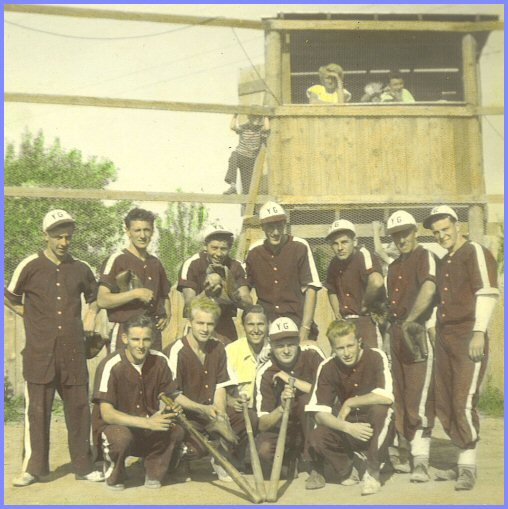 |
BR: George Derksen, Bernie Dyck, Pete "Happy" Wall, Henry "Tiny" Harder, Ernie "Nestor" Reimer, Jake "Brownie" Brown, Alex Fast
FR: Irwin "Wiener" Froese, Len "Leggy" Froese, John "Mex" Giesbrecht, George "Fuzzy" Enns, John "Vagy" Martens
Mary Froese & Cactus in the Announcer's Booth with Eddy Froese; Photograph: Hank "The Barber" Giesbrecht
|

Poster Courtesy of Mary Froese
Yarrow's Intermediate Softball team continued Yarrow's winning tradition to win the 1951 B.C. Softball Championship.
| Provincial Intermediate Softball Champions - 1951 |
|---|
 |
BR: Eddy Froese, John Dahl, Pete "6" Ratzlaff, Jake Wiebe, Hank Ratzlaff, Pete "7" Ratzlaff, Ernie Bergmann, Spike Klassen
FR: Rusty Bergmann, Hank "Crow" Martens, Irwin "Sally" Harder, Elmer "Slim" Neufeldt, Fred Adrian, Allan Wilkie
Photograph: Hank "The Barber" Giesbrecht
|
 |
After the rental agreement for the Wilson Road South ballpark between the Y.A.A. and George Knox expired in 1952, the Y.A.A. secured the use of the playing field at the Sharon Mennonite Collegiate Institute on Wilson Road North for Yarrow's softball teams. The bleachers at Knox's Ballpark were moved to the back of the school, visible in top left part of the photo: Yarrow School Grounds. Softball games, and later baseball games, were held here, even after 1952 when the Chilliwack School Board purchased the building and grounds to establish the Yarrow Elementary Junior High School.
At the General Meeting of the Y.A.A. on Tuesday, May 20, 1952, it was revealed that some members were collecting funds from Yarrow's merchants to establish community softball and baseball teams, independent of the Y.A.A. This group, including Johnny Giesbrecht, Ben Brown, and Len Froese, felt that the Y.A.A. was not making enough of an effort towards improving sports in Yarrow.
In subsequent meetings in 1953, the Yarrow Athletic Association decided to liquidate its activities as a registered club.
Yarrow's ball teams continued their winning ways. With its home field on the Yarrow School grounds, the Yarrow Baseball club won the Championship in 1953.

Crests Courtesy of Mary Froese
In the early 1950's, baseball replaced softball (fast pitch) as the team sport of choice for Yarrow's youth. Televised major league baseball, particularly World Series games, contributed to the rise in popularity of baseball. Residents of Yarrow without T.V. sets at home gathered at D.& D. Hardware or Epp's Hardware stores to watch and cheer on the New York Yankees or Giants, the Brooklyn Dodgers, or the Cleveland Indians.
The sponsorship of Yarrow's Junior baseball team by Yarrow's Ocean Spray division of Cascade's Foods greatly enhanced the team's competitive viability. See Yarrow's famous baseball team.

Crest Courtesy of Mary Froese
Ocean Spray of Canada Ltd. completed its Eckert Road plant in June 1954. It was purchased in January, 1955 by Mr. Marcus L. Urann and several other financiers who had formed Cascade Foods Ltd. Mr. Urann, a prominent American lawyer and businessman, was the President of Cascade Foods. A keen sportsman and former captain of the Harvard University football team, Marcus was a strong supporter of baseball in Yarrow. In his capacity as coach and manager of Yarrow Ocean Sprays, Eddy Froese attended the 1955 World Series in Brooklyn between the Dodgers and Yankees.

Courtesy of Mary Froese
Duke Snider hit two home rums to lead the Dodgers to a 5-3 win over the Yankees. Since this game was held on Sunday, most of Yarrow's baseball fans were unable to watch this game on T.V. at their favourite hardware store.
1950
| The Chilliwack Progress, March 1, 1950 |
|
Yarrow Span Plan Fading
Engineers Estimate Cost of Proposed Vedder Bridge $130,000
Prospects for construction of a Greendale-Yarrow traffic bridge over the Vedder River in the near future, faded sharply Monday when plans and estimated cost came before township council.
Two 200-foot spans 18 feet wide with a sidewalk on one side and center pier would cost $130,000 according to engineers of the provincial public works department. Three small bridges over sloughs would also have to be provided.
Two adverse factors in addition to the cost, which have to be borne entirely by the township, are:
1. Site not particularly favored by engineers;
2. Location of a bridge at the proposed crossing is opposed by Sumas Dyking Commissioner Bruce Dixon on the grounds that it would detrimental to Sumas reclaimed area.
Council members were unanimous in the view that even though the physical factors were more favorable, that submission of a debenture bylaw to ratepayers at this time would be unjustified and unwise in view of the heavy demands on township revenues.
The plans and estimates were tabled.
|

Wittenberg Jewelry circa 1950
1951
— — — The Chilliwack Progress, January 10, 1951 — — —
|
|---|
|
Mennonite Group Aids New Citizens
"Canadadian citizenship is a privilege, not a demand."
|
|
The above sentence is the byword of a unique project in citizenship taking place at Yarrow.
Sponsored by the provincial Mennonite Relief Committee, whose secretary, A. A. Wiens of Yarrow, is taking a leading role, literally scores of Europeans of German and Russian background who arrived here since the war are learning how to become Canadians.
Although the project only began in December, Mr. Wiens says that already almost 60 per cent of the 600 people in British Columbia under the wing of the Mennonite organizations have filed applications of citizenship.
"They want to become Canadians," says Mr. Wiens, who conducts an office for the purpose at Yarrow. "That's why they cam to Canada. We felt that we should help them out."
Of the 600 in the province, some 150 are in the Yarrow district and Mr. Wiens says that the percentage of applications has kept pace with that in other parts of the province.
The newcomers, practically all of whom have arrived since 1947, are busy adjusting their lives to their new country and orienting themselves to its customs. Aware of their difficulties, which include the barrier of language, the relief committee formed the idea of assisting them in getting acquainted with the modes of living in Canada and, at the same time, impress upon them the new responsibilities they would be called upon to assume.
The venture has the blessing of the federal department of citizenship, because it is an organized, voluntary program aimed at making the immigrants into Canadians.
|
"The matter of language is important," said Mr. Wiens. "I would like to see the study of languages more intensively directed by the school authorities. The night classes are doing a great deal of good, but in a community like this, where German is spoken by the older residents, we have an added difficulty for the new comers. If they were in places where English is spoken continuously, they would have to learn it quickly. Here, they can, and are inclined to, speak their own language all the time."
Preparation for the project was completed last November, and the actual program got under way in December. Chairman of the provincial Mennonite Relief Committee is Rev. A. A. Toews, of Abbotsford. H. M. Epp of Mr. Lehman is vice-president; and Mr Wiens is secretary-treasurer, and P. A. Klassen of Vancouver and J. C. Krause of Yarrow, are members.
The work cuts across church-lines, in that committee membership is drawn from both the Mennonite Brethren and the United Mennonite churches.
While interest on the part of the newcomers is keen, the project also is having repercussions among the longer-established people.
"There are quite a number of people who have been here for years and whose citizenship was obtained by their parents." said Mr. Wiens. "Many of these are taking out their own citizenship papers. It's not because they aren't citizens. It's because their proof of citizenship is contained in their parents' papers and they wish to have proof of their own citizenship."
In the last month, approximately 100 such applications for citizenship papers have been made.
|
|
|
— — — Community Portrait - Chilliwack Progress - January 23, 1952 p2 — — —
CORNELIUS CORNELIUS FUNK
|
|
 The story of Cornelius Funk of Yarrow is a heart-warming one of courage, perseverance and final success.
He arrived penniless in Yarrow in 1933, in the depths of the depression. Today, he operates a feed mill, feed store the town's most modern groceteria and a cold storage locker.
"When we arrived here, I didn't even have the money to buy a two-cent stamp to write my brother," he recalled, standing behind the big glass front of his store, an exterior which gives a tangible evidence of his success.
A quiet, scholarly man with a neat gray moustache, he told, in a detached, unemotional way, the story behind that prosperous glass front.
He told a story, like so many of his generation, of Communist oppression, seizure of goods, and final flight from under the shadow of the Russian secret police.
It was one more story of oppression and flight in the long history of the Mennonites. Originally from Holland, they moved to Prussia when their pacifism and rugged Protestant
faith roused the animosity of their neighbours. In German they sought refuge only to find the same animosity.
In the 18th century, the Empress Catherine the Great offered the Mennonites free land in the wild prairies of the Ukraine in southern Russia. Thousands of them made the trek and there they developed the rich land and prospered until the Communist revolution in 1917.
Then flight again - flight to Canada, which the industrious peace-loving Mennonites hope will be their last.
Before his flight Cornelius Fund had been a member of a family which had long been prosperous millers in the Ukrainian city of Selidowka. In 1919, when he was 25, their property had been seized but they had been permitted to rent the mill and operate it. This uneasy situation lasted until 1926 when the Communists felt strong enough to force out the business class, including the Funks.
Cornelius rented two acres of land which he farmed for three years, always in constant fear of the secret police and their informers who were everywhere.
"You never tell anyone what you are thinking... never," he said. "Always pretend you are happy."
By 1929, thousands of Mennonites had gone to Moscow pleading and demanding to be allowed to leave the country. It was dangerous to join the dissenters in Moscow but Mr. Funk decided to slip away and see if there was any chance of escape.
He told no one but the secret police still got wind of his trip and at night demanding to know where he had gone.
"My wife told them I had gone 'to town' and that I would be back in about a week," he said. "They said they'd be back."
His terrified wife, Susie, gave him the news when he got back and they knew they must leave immediately.
"If they found out, we'd be finished," he said. "We sold everything we had in a week."
Communists were stopping Mennonites at the railroad stations and refusing them tickets, so Mr. Funk went to another town, a mining center, where there were no Germans.
There unrecognized, he bought tickets on a "through' train which wouldn't make any stops until it reached the capital, Moscow.
"Many people were taken off the trains when they stopped at the big towns along the way." He explained.
At Moscow they were temporarily safe as there were too many Mennonites for the secret police to arrest.
"They told us to go back. 'No one wants you' they told us, but we didn't believe them" he said.
"Let us get out," we replied. "Even if we have to go across the border and die there, let us get out."
Finally, after many had been herded into box-cars and sent away, they received word the Germany would accept the Mennonites and the Funks were among 6000 who left.
"About 15,000 didn't get out and most of them have never been heard from again," Mr. Funk said.
Among those who stayed behind were two of his brothers and four sisters, all of whom have disappeared.
"The last time I heard from them was in 1935 when I got a letter from one of my sisters," he said. "Since then... nothing,"
They stayed only a few months in Germany and then came to Canada, where they stayed in Manitoba with a sister-in-law and her husband who were among a few Mennonites who had left Russia in 1926.
After two years in Manitoba, they moved to Alberta and then Mr. Funk saw an ad that land was available at Yarrow.
"You could get two acres of land and pay for it in seven years," he said. "It seemed to me there should be lots of opportunity in B.C. so we came out."
The first years were years of hard, bitter struggle to support a large and growing family. There didn't seem to be any sign of the opportunity he'd looked for.
After several years, in which he cultivated his two-acre plot and working out in the hop yards he began to wonder about the milling business, the trade in which he had been trained.
"I thought lot about it," he said, "but I didn't know how to start up.
 "Back in the Ukraine, we milled the grain the farmers brought in to us, but here the farmers don't grow enough," he continued. "I didn't have any money to buy grain, so I didn't know what to do."
Finally, in 1940, he got a small hammer mill and went to a local farmer with good oat crop and made him a proposition. The hopeful miller would take a few tons of oats on credit,
mill it and see if he could sell it. Then he'd pay for it and take some more. The farmer agreed and the tiny business began.
"For the first few months it was terrible," he recalled. "I wished I had never started. I kept going though, and after a while it got better."
From there on, it's been a Horatio Alger story for the penniless immigrant.
He began to buy grain in carload lots. Then he needed a small elevator to store it, and in 1943 he started his mill beside the railway tracks at Yarrow.
"Business was good by then," he said. "By then the mill was finished and we pretty well had it paid for."
 After that people began telling him he should have a store in town so customers wouldn't have to go over to the mill.
At first Mr. Funk was against the idea because it would mean hiring a man to run the store and he didn't think it was worth it.
"After a while, I decided to start a little store and I thought I'd sell a few other little things in the store to give him something to do," he continued.
After that people began telling him he should have a store in town so customers wouldn't have to go over to the mill.
At first Mr. Funk was against the idea because it would mean hiring a man to run the store and he didn't think it was worth it.
"After a while, I decided to start a little store and I thought I'd sell a few other little things in the store to give him something to do," he continued.
In a tiny 18 x 15 foot store they started the retail business which has grown until in 1950, he built the modern glass fronted building which serves both
the feed business and the town's largest groceteria. The latest addition to his growing business is a cold storage locker completed a year ago.
In this thriving business he's helped by three sons, Cornelius, Henry and Arthur who will someday take it over.
The future is bright for them, he thinks, as it is for his four daughters: Betty, Annie, Susie and Dorothy.
All are being raised by Mr. & Mrs. Funk as staunch Canadians who appreciate, more than most of their fellows, the value of their freedom.
Mt. Funk smiled broadly, his hand moved in an expansive gesture: "This is the finest country in the world."
|
|
— — — Chilliwack Progress - Community Portrait - February 6, 1952 — — —
NICKOLAI REIMER ... nurseryman
|
|
 Nicolai Reimer, Yarrow nurseryman who departed Russia some 28 years ago. He is engaged in an operation to bring out another refugee from Eastern Europe. It is a Crimean apple which he remembers from his boyhood as the most succulent ever to pass his tonsils.
The tree, like many a former human resident of Russia, will be brought from Germany where it was found growing in a few orchards, having apparently been taken there sometime during the last few years.
Mr. Reimer, who is contentedly assisting nature to produce a wide variety of superior plants on his 30 acre farm on Boundary Road, Yarrow, says that the Crimean apple, to his recollection, is the best table variety produced in Russia and he is pleased at having found the opportunity to establish it in Canada.
"It is a winter variety, red cheeked and juicy," he says, " I am getting a few buds from Germany."
 Importing European plants is a regular procedure in the business which Mr. Reimer has built up since he budded his first seedlings in this country in 1934. Today, his nursery operation has reached the stage where it is mostly at the wholesale level - supplying seedlings and decorative plants and shrubs to retailers in all parts of Canada.
Many of these come from Holland, a country long established in the nursery business. Currently, the Dutch growers are a mixed blessing to their Canadian counterparts. Not only do they supply many Canadian nurseries, but they are also in a position to compete with them on the Canadian market.
The present thriving condition of business and personal contentment which Mr. Reimer admits to enjoying developed simultaneously. It couldn't be otherwise, since plant biology is his hobby as well as his source of livelihood.
Pictures in a school book which was placed on his desk when he was a boy in southern Russia fixed his interest permanently on plants, but it was not until he settled in Yarrow many years later that he was able to develop it to his satisfaction.
Mr. Reimer was born in the southern Ukraine and moved with his family to the Caucasus, near the Caspian Sea at the age of seven. He grew up near the town of Marjanowka, where his father was a farmer.
The war, in which he worked as a hospital sanitarian and the subsequent Revolution, terminated the quiet farm life which he had known. Two weeks after returning from war service, he and his family fled from the Caucasus to a town on the Black Sea where they lived for six years. He came to Canada in 1924 with his wife and small daughter.
 They settled at Langham, Sask., near Saskatoon, a country where the permanent inhabitants are alleged to be fur-bearing and half-hearted winters are unknown.
"I grew up in a warm country, with a climate similar to Chilliwack's" said Mr. Reimer. "It was too cold in Saskatchewan. We farmed 160 acres there for four years, then, we came to Yarrow in 1928."
The occupation of growing things from the soil is a way of life followed by the Reimer family for generations in German and Russia. The southern Russian country side he knew was similar in many aspects, particularly fruitfulness, to the Fraser Valley. Types of crops which could be grown here were much like he had known in the Ukraine and Caucasus.
His initial effort beside the Sumas dyke was a dairy farm, which operated until 1935. That was when he became interested in growing plants.
 "In 1934, my brother-in-law brought me 20 seedlings and asked me to bud them, and my old interest returned. In 1935, I bought 120 seedlings. I liked it so much that I sold my cows and went into the nursery business."
To his original 15 acres, which he still owns, he had added 14, seven of which he rents and seven which he owns. This year, he will bud 120,000 seedlings - roses, fruit and ornamental trees.
"I began by retailing my plants around the district, but in recent years, I have been wholesaling more and more. The bulk of our plants are now sold to dealers and nurseries, some as far east as Ontario."
Among his early advances, which still gives him great satisfaction, was the importation of the Kassins cherry from Germany. This variety is black, resembling the Bing in colour and taste and has the added virtue of being an early ripener. It bears as early as the end of May.
 While Reimer's first love is growing flowers and ornamental trees; much of his business is in fruit trees. He is a strong advocate of dwarf trees.
"With dwarf tress, you get excellent fruit, in many cases better than from large trees and they bear within two years," he says. "A good plan is to plan is to plant dwarfs at wide intervals in large trees between. It isn't necessary though, because dwarfs bear up to 20 years."
His Dutch imports range through the whole catalogue, from bulbs to trees. This year, he is importing European varieties of beech, birch and maple from Holland. These, he says are magnificent ornamental trees.
"I like to deal in flowers and ornamental trees best"
Like any other business of the soil, it has its risks. He considers himself one of the lucky ones in the 1948 flood. His land was not ravaged like that of his Greendale neighbors across the Vedder Canal, but he did lose 12,000 cherry seedlings from seepage. Last year, he stood a $3,000 loss on the importation of peach seedlings from California. "I bought 6,000 seedlings and lost the whole lot when they were fumigated at the border," he said. "I guess the fumigant they used was too strong, anyway the whole lot died. It was quite a blow.
Last year, he employed irrigation for the first time and was highly pleased with the result. He installed 1,200 feet of aluminum pie from a nearby drainage ditch.
"It worked wonderfully," he declared. The growth rate was excellent during the driest part of the summer." He markets large amounts of raspberry canes, most of which he buys in the Yarrow district. His market for these is largely in eastern Canada.
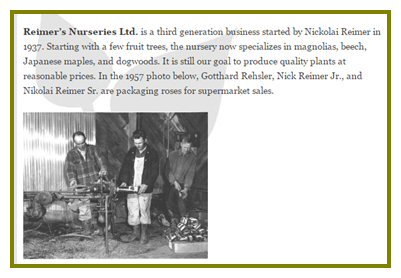 As far as Mr. Reimer is concerned, the Newberg berry is still king. It is the most popular because, generally, it fulfils to the greatest extent, the requirements of the growers. The Willamette berry, which is reported to be showing great promise as a commercial variety, has not yet become popular.
Mr. Reimer is as a fair a representation of a man who has found contentment as this district can show. His livelihood is his hobby, and the business which has built up eventually will be passed on to his son.
Nick Jr. age 24 already has assumed much of the responsibility of the operation of the nursery, which during the summer keeps four men and three tractors busy.
Stalwart adherents of the Mennonite Brethren Church, Mr. & Mrs. Reimer have four daughters in addition to their one son. They are Margaret, attending college in California, Frieda and Mary going to Bible school in Manitoba and Hilda, a student at Chilliwack Senior High School.
|
1953
|
— — — Chilliwack Progress, April 1, 1953 — — —
Wilson, Yarrow Central Roads Newly Paved
|
|
Work proceeded at full speed on the municipality's $250,000 road paving project this week, as the crew worked to use stockpiled materials at the Brown road plant
before rising water in the Vedder River interferes with operations on that site.
A two mile section of the Vedder Mountain road from the BCER tracks to the Brown road has been paved, leaving undone the remaining mile and a half to the Cultus Lake Road,
which is to be relocated at a later date.
The Wilson Road has been completed and the First Street was completed today. The next paving on the project list-a three quarter mile length on Boundary Road.
After the completion of the paving projects around Yarrow the plant will be moved to another location, probably on Bailey Road.
|
|
— — — Chilliwack Progress, April 29, 1953 — — —
J.H. Martens Quits Yarrow Water Board
|
|
Councillor John H. Martens has submitted his resignation as chairman of the Yarrow Waterworks Board.
He gave pressure of business both municipal and private as his reason for quitting the five-man organization which in effect is Yarrow's unofficial village council.
The vacancy will not be filled immediately, but board member H. H. Goossen will replace Mr. Martens as chairman. Other board members are William Schellenberg, H.G. Sukkau, and P.P. Giesbrecht.
The board passed a resolution urging the municipal council to extend the Yarrow Central and Stewart Creek ditching zones to include properties on Boundary Road.
The new chairman was asked to call a meeting with Chilliwack representatives to plan Yarrow's 25th anniversary which will be celebrated on May 27th.
|
|
— — — Chilliwack Progress, Wednesday May 27, 1953 — — —
Yarrow Water Board Solved Emergency
|
|
"Unofficial Village Council"
Organized seven years ago to correct a dangerous community sanitation situation, Yarrow Waterworks Board has developed into the area's unofficial "council".
As the only body in the community enjoying official status, it has been called on to perform numerous duties outside those set down in its charter under the provincial Water Act.
Among them was that of organizing the community's 25th anniversary being observed today.
Now under the chairmanship of Henry Goossen, the five-man Water Board has, in its brief lifetime, become the sponsor of the volunteer fire department,
intermediary between the Yarrow ratepayers and the mouthpiece for organized opinion in matters affecting the community.
It began in 1944 when low-lying Yarrow found itself with an impossible sanitary situation beneath it. Seepage from barns and septic tanks was contaminating wells throughout the area to an alarming degree.
In March 1944, the then unofficial village committee called a meeting of residents to urge action on some sort of program which make uncontaminated water available to all.
The ratepayers endorsed the idea enthusiastically.
Henry P. Neufeldt and Henry Sukkau were delegated to go to Victoria to interview the provincial Water Rights branch to get permission to tap Volkert and Knox creeks as water sources.
"We were given verbal permission to start work immediately and told that written permission would be forwarded later". Mr. Sukkau, still a member of the board recalled.
That was in April. In June written permission arrived. It required that we have the work completed in five years. The water system was completed less than two months later.
The main system at that time consisted of eight miles of 10-inch and eight-inch wood stave pipe. It has since been extended to slightly more than 9 miles.
Seventy-five subscribers paid $185 each, some in instalments to finance the venture. Since then, the number has risen to more than 160.
Last year the board completed construction of a 25,000 gallon reservoir on Vedder Mountain which assures adequate storage for the needs of the community for years to come.
|
— — — The Chilliwack Progress, Thursday, May 21, 1953 — — —
|
|---|
|
Yarrow Marks 25th Birthday Anniversary
|
|
Village Anniversary
Yarrow people will celebrate the 25th anniversary of founding of their village on Wednesday.
The quarter-century observance will be marked by a day-long program which will highlight historic, social and religious aspects of the thriving Mennonite community.
Pioneers will recall the village's beginning in 1928, when the late C. Eckert advertised for Mennonite settlers to come to a land of promise. They came from all parts of Canada and later, from Europe.
Speakers will tell of its fluctuating prosperity which has been accompanied by a steady growth resulting from hard and persistent work.
Resident of other parts of the valley will be welcomed to the anniversary and special invitations have been sent out to more than 100 district people in official and semi-official positions.
|
At School Grounds
Site of the anniversary will be grounds of the new Yarrow elementary-junior high school, the former Sharon Mennonite Educational Institute. It will start at 10 a.m. and continue until 2 p.m. when there will be a luncheon.
The afternoon will be given over to sports and a concert by the Chilliwack senior band.
In the evening, there will be a concert by the Walter Neufeldt string orchestra and moving picture showing.
The Yarrow Waterworks Board, which is in charge of the program, is still working out details of the program. Chairman will be H. H. Goossen and speakers will include Reverend Hermann Lenzmann, and Reverend John Klassen of Yarrow.
W. Lyle Macken, Chilliwack, will be guest speaker.
|
|
|
— — — Chilliwack Progress, Wednesday May 27, 1953 — — —
Editorial Page - L.E. Barber, Publisher
|
|
In Twenty-Five Years
The people of Yarrow are today marking the silver anniversary of the arrival of the first Mennonite settlers in the district.
Twenty-five years ago Yarrow area was largely wasteland. The handful of newcomers who arrived to make their homes there were not unlike the pioneers of an earlier day.
Money was scarce and facilities in the particular area to be settled were few. The means of making a livelihood from small acreages had to be found and raspberries provided the answer.
Up went homes, schools, churches and stores.
Now Yarrow district has an estimated population of 2000; it is almost a self-contained area with Yarrow Water Works board serving as unofficial council for what is now the valley's largest raspberry producing center.
The people of the area soon overran the confines of their community and along with thousands of Mennonite families from the prairies spread into every nook and cranny of the Chilliwack and Abbotsford areas.
Both districts grew by leaps and bounds. The birth of Yarrow brought a rebirth to the upper and central sections of the valley.
In the last 25 years, people of Mennonite faith have exercised a profound effect on the religion, culture, economics and politics of the city and township.
Among their numbers are men and women who are making outstanding contributions to the life of the community.
The ripple caused by the original settlement has grown into a wave. The significance of Yarrow's anniversary is valley-wide. All people of the valley will join in congratulating the people of that community on their achievement and on the industry, thrift, initiative and deep religious convictions which are its foundation.
|
|
— — — Chilliwack Progress, Wednesday May 27, 1953 — — —
Co-op Leader Helped Berry Industry Get Started
|
|
Marketing Early Problem
The problems of marketing have been a major concern to Yarrow's J.C. Krause ever since the land began to yield for the pioneers who ripped out the stumps a quarter of a century ago.
He lives comfortably now on the 10 acres which he bought from the late C. Eckert, but he can recall when there were no comforts and very few necessities.
"Looking back, I sometimes wonder how we did it" the tall, genial farmer and co-operative leader said. "If it had not been for the help given us by Mr. Eckert, it would have been even more difficult."
While building a house and readying the land for production, Mr. Krause found that it was necessary to take on outside jobs to carry on.
Mr. Krause worked for eight years at the Canadian Hop Company at Sumas Prairie and developed his holding at the same time.
LONG WORK DAY
"We used to walk four miles to the hop yard, do a day's work, walk back and then do our farming. "It was a great day when one of us bought a horse and we took turns riding to work."
The initial problem confronting the pioneers after the land was cleared was what crops to grow on it. The settlers were encouraged to raise sugar beets,
but this turned out to be an ill-fated venture since the land was not suitable for them.
"We tried spinach, head lettuce, beans, peas, and many other crops before it was found that raspberries and strawberries would thrive. Even after we started to grow small fruit, we had plenty of trouble."
|
|
— — — Chilliwack Progress, Wednesday May 27, 1953 — — —
Yarrow Pioneer Recalls Community Beginning 25 Years Ago
|
|
Of the original families which came to what is now the thriving community of Yarrow in the spring of 1928, scarcely more than half a dozen remain.
Among them is J.C. Krause, whose willingness to undergo the hardships of a pioneer was backed up by a capacity for leadership which has had its influence on Yarrow in the last quarter century.
A leader in the co-operative movement, Mr. Krause was many years manager of the Yarrow Growers Co-operative Growers Union, which he helped to found.
His recollections of the founding and development of Yarrow are delightfully told in the following story. (It was written in German and translated by Phil Penner, English teacher at Chilliwack High School.-Ed)
|
|
|
The originator of the movement of Mennonites from the Prairies to British Columbia was the late C. Eckert.
With E.A. Crain, he acquired the land near Yarrow for the establishment of a Mennonite settlement after an attempt a few years earlier to settle the area with people of Ukrainian origin failed.
In response to Mr. Eckert's advertisement in the "Winnipeg Free Press Prairie Farmer" fifteen families arrived in the spring of 1928.
Most of the arrivals knew nothing of each other but shared the common experience of failures in Saskatchewan. My own experience serves as an illustration.
I had bought a fully-equipped farm near Davidson, Sask., with a dollar down but with a one sided contract advantageous to the owner and I was soon convinced that eventual ownership was impossible. By chance the B.C. advertisement came into my hands. I sold the few assets we had acquired in two years and we had just enough money to pay for our move to the beautiful land of British Columbia.
LEFT IN SNOWSTORM
On February 16, in severe snow storm, a kind neighbour brought us to the station in Davidson. We put our future into God's hands and wife and I and four small children sped into the night and into the unknown.
After an exciting and interesting trip through the Rockies, we arrived in Chilliwack on February 19 and were greeted by the gentle warm air of spring.
After a few hours of waiting, the train brought us to Yarrow. We were the fifth or sixth family to arrive in response to the advertisement in the "Free Press Prairie Farmer".
More arrived the next day. Most of us found temporary shelter in a large farmhouse a mile up the mountain road.
For several weeks we lived in close quarters. We spent the days with Mr. Eckert who showed us his land and talked big plans.
It did not take him long to discover how much money each of us had. Eventually the time came to choose the location of our homestead.
After this was done, Mr. Eckert ordered lumber by the carload for homes and outbuildings.
At this time Wilson Road was the only road in Yarrow. Consequently, when the lumber arrived at the Yarrow station, it had to be hauled by a team of horses provided by Mr. Eckert.
A chain was thrown around a pile of lumber and the horses, hitched to the pile would start off across the fields. Often the whole transport bogged down in the mud or the harness tore.
Occasionally there was a runaway to add to the difficulties. But progress was made and with the co-operation and mutual aid a few homes were soon at the
stage where each family could "make do" and find shelter under its own roof.
ROADS IMPASSIBLE
The present main street of Yarrow was at that time an old broken down fence along which clumps of giant poplars score the sky with their branches.
It was a time when everyone performed work for the community. Roads had to be made passable. The horses owned by some, did their share of pioneer labor.
If they strayed a few feet off the new roads, they often bogged down and had to be pulled out.
There were no exact boundaries and consequently no fences existed to keep cattle within bounds. It was not uncommon to be wakened at night my strange cattle rubbing themselves on the house corners.
In March of our first year we began working in the hop yards. How often we walked the three and one half miles to the Canadian Hop Co. Yards on Sumas Prairie.
How great was the occasion when a neighbour D. Remple and I had prospered enough to be able to buy a small horse for twenty dollars!
The horse became the general factotum of the farm. Because Rempel and I could not ride the horse at the same time, one of us would ride a stretch and then tie the horse to a tree and proceed on foot.
This alternated riding and walking shortened the long road to the hop yards. "Dolly's" reward was a day of grazing.
WHAT TO PLANT
Into the midst of all these activities came the pressing necessity of preparing the land for planting. The problem was what to plant.
Mr. Eckert had many ideas but few concrete plans. At this time a "smooth" agent from the South appeared on the scene who maintained the land was extraordinary suitable for the cultivation of sugar beets.
One year's production would reduce our indebtedness by hundreds of dollars. Some "fell for his line" but others decided to try green beans.
The result of both experiments was a total failure. The beets either smothered in weeds or rotted during the high water.
The optimistic bean growers were unpleasantly surprized when many sacks of beans were returned to them from the canneries in New Westminster.
They were left holding not only the bags of beans but also bills for freight. One expectant farmer, upon calling at the cannery at the end of the season to get his cheque, received on for thirty-five cents.
Many things were given a try the first few years. After sugar beets and beans, the following had their turn: head lettuce, asparagus, cabbage, carrots.
Finally, we planted rhubarb, strawberries and raspberries. It should be mentioned that we had some success with peas but the harvest was very uncertain.
Another thing-aside from failure, our inexperience-made for hardship in the first years-the depression in the early thirties. Average pay for labor was fifteen cents an hour.
Hop picking paid 1 ¾ cents per pound. Those with grown children had an advantage.
What these young people earned, whether it was boys working by the hour or girls working as domestics in Vancouver, went to the support of the family home.
How grateful we are to the late Mr. Eckert, who was indulgent about the strict terms of the original contract. He extended the term of payment and forgave accumulated interest.
He foreclosed on no one, not even on those who repaid good with evil.
SUSPECTED MENNONITES
It is not to be wondered at that the old settlers did not always welcome us with open arms. For one thing, the name "Mennonite" was strange to them.
Many confused us with Doukhobors and other notions were current. One local friend hopefully reminded us that high water would soon drive us out.
He advised us to have a boat tied to the house for such an emergency. The government in Victoria was also informed that these people in Yarrow were living below subsistence level
and would undoubtedly become a burden on the taxpayer. The result was that an official did come to investigate but found everything to his satisfaction.
The fact that Yarrow school population was growing created a problem for the local school authorities. At first some of the children attended the mountain road school where Miss Currie was the teacher.
In the second year of the settlement a one room school was built. About two years later, another similar building was added to the first.
Here it should not be forgotten that Carl Wilson appeared on the cultural scene in Yarrow and served as principal of the school and mentor of our children. His patience and understanding is acknowledged with thanks.
The first ten years were the hardest. The majority of the settlers were poor and had to work out by the day in order to assure their livelihood and to make payments on the land.
As time went on, it was possible for the heads of families to remain on the farms. Barns had to be built and gardens and raspberries had to be looked after. This was the general situation in 1935.
In 1937 a Co-op was organized with the object of marketing our products and without doubt this organization has contributed much to raising the economy of the Yarrow community.
BUILD CHURCH, SCHOOL
The first church services were held in private homes. When the first school building was ready we were permitted to hold services there.
In 1932, the first church was built by the Mennonite Brethren congregation. This was soon too small and in 1938, the present spacious church building was erected. The First Mennonite church was built in 1936.
The year 1936 was a momentous one in other respects. The BCE in that year extended the power line to Yarrow. It was however, not until 1946 that our main street and Eckert Road were paved.
In 1944, the Yarrow Water Board was organized and our own water system was installed.
Now after twenty-five years how things have changed. Many ten acre farms have been divided into smaller holdings. More and more people are retiring to smaller acreage.
The original population of twenty-five (families) has swelled to a total to two thousand in and around Yarrow.
One family of old-timers, who were here before our arrival twenty-five years ago are the W. Siddals.
For many years the Siddals had a grocery store at Yarrow Station and later, when the population increased, Mrs. Siddal became our Postmistress.
Bill Siddal is a great friend of children and seems to know them all by name. He even speaks some Low German! In 1947 the Bank of Commerce established a branch in Yarrow.
All these changed have helped to make Yarrow a self-contained community.
Of the thirty Mennonite congregations in B.C., Yarrow MB Church with 800 members is the largest. The First Mennonite Church has a membership of 200.
WIDESPREAD GOOD WORKS
The office of the Provincial Mennonite Relief Committee is situated in Yarrow. This organization is supported by all Mennonite congregations in the province.
A total of $900,000., mostly from direct donations has been distributed by this organization to help displaced persons, widows and rehabilitate European refugees in South American countries, particularly in Paraguay.
Financial aid to the sick and mentally ill has also been extended by this organization. We are grateful to be living in a country which has enabled us to prosper and had given us the opportunity to
lend a helping hand to those less fortunate.
Today marks the end of twenty-five years. An anniversary such as this is a time for stock taking and reflection. As we look back, no one can deny that we have prospered.
All of us are thankful for the homes we have been able to establish here. Our children have had opportunity for education and many have found their place in the professional and business world.
We have also been able to participate in local affairs. In the long school of "give and take" the newcomers and the old settlers have learned to respect each other and work together.
It is our sincere desire that this feeling of mutual respect continue to grow for the benefit of the community as a whole.
The older ones among us as saddened by the memory of those who still behind the iron curtain of the "Red Paradise". This should remind us to thank God that we live in a country like Canada.
May God bless and long preserve Canada and our beautiful B.C.
|
|
The Chilliwack Progress - January 20, 1954 - page 2
Community Portrait
Henry Goossen ... cab owner and operator -

A man whose whole life has been motivated by his earliest recollections of people starving to death during famine in Russia, fear and terror of a brutal regime in that country after the
revolution, and intrigue and revolt in Mexico now lives and works in Chilliwack.
This man believes that anything worthwhile is worth working for. He wants to see through to the finish any project that he starts. Because he recognizes the true value of democracy
he works in any public capacity or any public service that will help continue freedom of speech, freedom of the press and freedom of worship.
Henry Goossen comes in contact with a great cross-section of people in his present occupation as cab driver and owner of the taxi business and ambulance service here.
He likes people and had been educated to live with and for people long before he bought the Chilliwack Taxi and Cunningham Taxi businesses on April Fool's Day, 1948, and Henderson's Ambulance Service,
New Year's Day, 1953.
Henry and his wife Teenie, and son Henry Alvin, came to Yarrow March 18, 1943, from Manitoba. He first tried his hand at farming and at the same time worked at a job with the local nurseries and hop yards.
In the fall of that year, he was offered the position of assistant manager of Yarrow Grower's Co-op. After working in this capacity for a year and a half, he went into business for himself.
He bought the Yarrow Box Factory and turned out millions of fruit boxes and crates of all types for fruit growers. Then he went into partnership with J.P. Martens and J.J. Jantzen and
started Central Merchants' Hardware in the heart of Yarrow. In 1947 he sold the box factory in order to devote more time to the hardware business.
Having become attached to Yarrow and firmly believing that there was no better place to live, he built a new home there.
In 1948 the partners sold the hardware business, which is now called D and D Hardware and started the Sunripe Fruit Packer's Ltd., a firm which Henry managed for two years.
In 1951, C.H. Penner was taken into the partnership and he has since been the manager while Henry devotes his time to the cab business and public services.
For six years, Henry has been a member of the Yarrow Waterworks Board this last year in the chairman's position. During his service on the board he has seen the community develop and expand.
Services rates to householders at Yarrow are one dollar a month and for a number of years, a rebate of five dollars a year has been returned.
Yarrow Waterworks Board is a beehive of community projects. It included a telephone exchange at Yarrow, street lights, paved sidewalks and a paving program in conjunction with
the municipal council. A 100,000-gallon water tank on Vedder Mountain insures a constant water supply.
The community boasts a streamlined fire department with a good fire engine, more hose lengths and better equipment. Yarrow has no drainage problem now,
thanks largely to the water board who dug ditches, cleaned ditches and put drainage systems.
Henry Goossen represents the village of Yarrow on the executive of Chilliwack Board of Trade and on the hospital board. He is the Hospital board's youngest member and says he has a lot to learn,
but is happy to serve wherever whenever it is possible. At the request of Reeve W.R. Richardson he represents the municipality of Chilliwack on the British Empire Games Committee and is an
executive member of the Upper Fraser Valley Society for Retarded and Handicapped Children.
Born in the Ukraine in southern Russia January 2, 1916, one of a family of four children, John and Jake, who are farming at Manitou in Manitoba and Martha, a student at United College in
Winnipeg as well as an adopted sister, Mary, who is married and lives in Manitoba. Henry and his brothers, sisters and parents came to Canada in 1925.
It was a long roundabout trip to the new country of freedom from a land of terror.
Henry's father was a scholar and pastor of the village church, therefore a key man of the village. Life at the age of six years was horror. People starved to death, died wherever they fell by
the roadsides, in hovels and homes. Skeletons with the merest breath of life walked around in a land of suffering famine under a reign of terror following the revolution in Russia.
His father was picked up with five other key men of the village and marched to jail at the point of a gun to be released on bail scrounged up by the villagers. In that land of starvation,
bail was set my amounts of foodstuffs, eggs, hams, vegetables, etc. If the bail was not met by the village, the key men were shot, 10 more men were taken into custody, bail set and if not met,
the program was carried on until all the male population of the village was destroyed.
Upon his release, Henry's father decided to leave the country to seek Canada. The family received their visas and passports from Moscow and migrated to the Netherlands intending to sail to Canada.
Apprehended by members of Russia's people's regime, they threw their passenger tickets to the wind and boarded a passenger freighter going to Mexico. Stops at Lisbon and the West Indies are remembered
by Henry who never missed a meal on that 26-day ocean trip which boasted calm crossing except for one day. Sunshine, cocoanuts and pineapple are what he remembers about the West Indies.
Tragedy stalked the fleeing family aboard the ship when his brother nearly died of blood poisoning, the result of careless inoculations given in the Netherlands.
A Spanish student doctor saved his brother's life. They arrived in Mexico in 1923. Henry's father took land at Rosario and farmed there for two years. Revolts were in the offing again,
so the family applied for and received immigration papers to come to Canada.
Henry remembers the whole family worked towards the finalizing of plans to come to Canada. He himself learned how to tell the soil with a wooden plow and yoke of oxen. The farm produced green
vegetables, potatoes and corn. Peanuts proved a poor venture. At the end of two years there was enough money to pay passage and invest in some land four miles south of Plum Coulee in the
Winkler district of Manitoba. On the trip to Canada, Henry remembers stopping at Emerson on a cold windy day amid huge banks of snow. He wished fervently that he was back in Mexico where the sun
shone all the time.
For the sake of educating his family, Henry's father sold his share of the 160-acre farm at Plum Coulee and moved to Manitou. Henry graduated from Grade 12 during the hungry 30's and went to Normal
school in Winnipeg the year of 1936-37.
For five years, he taught school in the southern part of Manitoba.
In 1939, he married Teenie Braun who was born and brought up in Altona, Manitoba. They now have three children, Henry Alvin, 12, Gloria Joan 9 and Grace Catherine 3.
He and his wife and children all love to travel. A picnic dinner at Princeton is a pleasant day. They have enjoyed trips across Canada, the United States and California.
If and when Henry has time to read, it is current affairs, the daily newspapers and Reader's Digest. His preference in music is classical and spiritual.
A member of the Mennonite Brethren Church at Yarrow, Henry believes in Yarrow's future. All the potentialities for basic industries are available.
It is his fondest dream that Chilliwack and district will have great industries in the future so that youth of the valley can stay at home, make a good living and contribute to the community.
|
1954
1954 British Empire and Commonwealth Games
The Vedder Canal Hosts the Rowing Events
|
Canadians Bobby Williams in single sculls, and
Donald Guest & Lawrence Stephan in double sculls win bronze medals.
Canada wins the gold medal in eights rowing.
|
|
| |
The Vancouver Province, Thursday, August 5, 1954
Canadian Rowers Sink Mighty England |
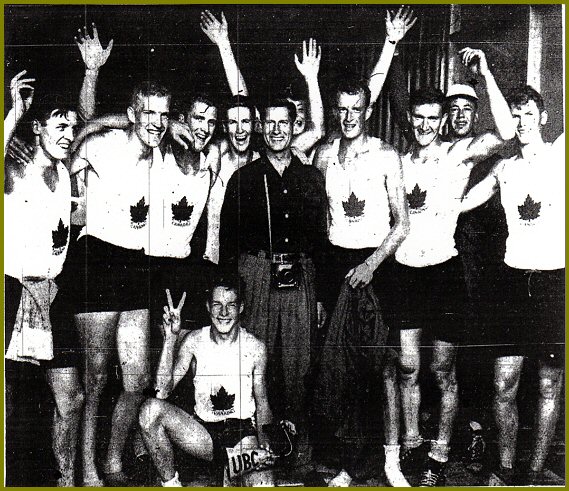 |
Ken Drummond, Doug McDonald, Captain Tom Toynbee, Mike Harris, Laurie West (partly hidden), Glen Smith, Herman Zloklovits, Phil Kueber, Bob Wilson
Coach Frank Read, Centre, Coxswain Ray Sierpina squatting in front
|
|---|
|
UBC's 'Green Kids' In Rowing Triumph
Great Thames Crew Defeated in Empire Games Upset
by ROSS MUNRO
A crew of courgeous undergrads from the University of British Columbia, where rowing is a minor sport, has soundly trounced the finest eight England can put on the water.
It is a good thing there's been Everest and Bannister's miracle mile, for the Canadian rowing eight, in the biggest upset of the British Empire and Commonwealth Games, shook a citadel of English sportdom when it finished the 2000-metre course 2 1/2 lengths ahead of the Old Country shell.
Canadians Finish Smoothly
The crowd of 10,000 lining the Vedder Canal for the rowing finals Wednesday was so stunned by the fantastic efforts of the UBC lads that they nearly forgot to cheer.
The crack English crew from the Thames Rowing Club, which had been defeated by only a half a length at Henley by a Russian crew that is now the favorite for the eights at the 1956 Olympics, had been heralded to win this one in a breeze against the tyro college team, the only other entry.
But the Canadians, after a faltering start when they caught two crabs in the first five strokes that nearly brought their weaving shell to a stop, caught up with the Englishmen at the 500-metre mark and pushed ahead from then on.
|
 |
|
England Seems Safe Winner
They finsihed smoothly with the excited Canadian coxswain, Ray Sierpina, spraying water on his crew as they crossed the finish line for a victory that marks the UBC team as a strong contender in the 1956 Olympics, if it can be held together and given facilities for training it needs.
Watching his first B.E.G. event, the Duke of Edinburgh was sitting in the stand at the finish line, along with External Affairs Minister L.B. Pearson and Defence Minister Campney.
Dr. Norman MacKenzie, president of the UBC, beaming like a freshman, rushed to the float to great his students when they finished and enthusiastically grabbed Coach Frank Reid by the hand. "A great effort; a great effort," he said. "We are very proud of you all."
Why did the UBC eight win the big rowing event?
The boys in the crew gave two reasons: the wonderful coaching of Frank Reid, a great sportsman; and the fact that nobody could have trained harder than they did.
|
 |
|
More than 10,000 spectators lined the banks of the Vedder River Canal to see Canada's greatest victory in the British Empire and Commonwealth Games.
They cheered long and loud for the victorious University of British Columbia crew.
Also watching from the royal box was the Duke of Edinburgh.
|
|
1955
|
The Chilliwack Progress - Jan 19, 1955 - page 5
Lush Farm Land Once Mosquito Paradise
Feudin' Fussin' Fightin' Marked Sumas Lake Reclamation Project
by Jim Peters
The hum of the big centrifugal pumps at Sumas pumping station is a sound unnoticed by most people but behind that sound lies a story of one of the largest land development projects in the history of British Columbia and legal "feud" that lasted nearly 50 years-the battle to reclaim Sumas Lake.
Now in 1955, a modern paved highway winds through the beautiful farm lands of Sumas Prairie to the coast and the area is rich from the growth of agricultural products and the efforts of men to produce them. But in 1876 when the first scheme for reclamation was announced, Sumas was a mosquito-infested lake hiding 33,000 acres of the finest alluvial farm soil in B.C.
With the letting of contracts for the reclamation in 1920, a 30 year fight that had been waged according to a Progress account of the time, "with all the bitterness of a Kentucky feud" was ended. But it really was only the beginning.
Small landowners in the area were up in arms over the scheme. The objected to the lands being bonded, feeling that the government should finance the scheme and assume the responsibility. Many farmers grazed their cattle in the lowlands, when the spring floods subsided. Ratification of the scheme meant that all this grazing land would be lost to them. They would even have to fence their own property.
At 6 pm on a night in November, 1920, a young farmer strode into the offices where voting was taking place on the scheme, glanced hastily at the books and saw that opposing forces, of which he was a member, were in the minority. "Come in with us," someone said. "No sir," replied the farmer firmly, "the ship may be sinking but I'll never desert her."
The vote was 144-21 in favor of reclamation.
CONSTRUCTION
The first phase of the work was construction of Vedder Canal at the cost of $600,000. Included in this phase was the Fraser River dyke, Sumas Canal, Arnold Creek interception ditch, Marshall Creek improvement canal, the Vedder River seepage ditch and a barrage dyke.
The lake was drained by cutting off the Vedder River from its natural course and diverting it through the canal. This was the original scheme proposed in 1876 by Lieut. Governor Dewdney. In 1906 the Sumas Development Company surveyed the land and drew up plans for the scheme.
Several other proposals, including one to redirect the Vedder into its former channel failed because of lack of funds and public support.
Second phase was construction of the Sumas River controlling dam and a battery of 5.54 inch centrifugal pumps with a capacity of 1000 cubic feet of water a second.
LAKE GOES
In January 1921, there were 200 men employed on the job. On August 16, 1923, the lake was down one foot with two 24-inch centrifugal pumps housed at the foot of McGillivray slough draining off 360,000 gallons per minute.
Many were the arguments for and against the reclamation as the lake water receded. In the spring of 1922 the project came in for a barrage after failure of the engineers to construct a temporary dam on Sumas River to hold back the Fraser River freshet. The dam was started but not completed as it was too late in the year. This, combined with a severe winter in 1921-22, set back operations somewhat.
The biggest factor in eventual development of the lake lands was the fertility of the soil and the low cost by which it could be made available to settlers. Average cost was $100 to $125 per acre. Government estimated average bush land would cost double that cleared.
In 1923 the first crop of oats was produced on land that had formerly been flooded every summer. The yield was two tons, or 120 bushels to the acre. Average yield of oats was three-quarters of a ton or 45 bushels to the acre on normal bush land.
LIFE FORCE
Sumas Pumping station was and still is, a life force for Sumas Prairie. The small grey cement building set just off the highway contains two 485 horsepower and two 1250 horsepower electric pumps which keep Sumas from returning to its natural state.
Water still lies on the lowlands after recent rains and the pumps must pick it up and throw it behind the station into the Sumas Canal which runs into the Fraser River.
Construction of the Vedder Canal dykes was on the biggest jobs. Bulkheads were constructed to hold materials and mud was then pumped in suspension the bottom of cut by suction dredge. Water was run off and the clay hardened. Bulkheads were then torn down and a dragline excavator built the dyke to its proper height.
River steamers have not yet made use of the Vedder canal as predicted in one of three essays written in 1922 on what the reclamation would mean to the valley, but the facts are as timely today as they were then.
The prize winning essay, reprinted in The Progress, set out the heart of the matter. "The 33,000 acres of Sumas Lake was a breeding ground for mosquitoes and a hunters' paradise of wild ducks, neither of which was of any economic benefit to the economic life of BC."
PREDICTIONS
The article stated the area was capable of maintaining over 3000 agricultural families and two towns with a population of 30,000 each. Agricultural products would $40 to the acre or $1,320 per year.
Another facet was stated in a second essay. Reclamation would open up a fertile area lying outside the dykes which was formerly of no benefit to anyone. The unbroken soil was ploughed, worked and planted with potatoes. Yield was nine tons to the acre.
May 1, 19223, the government placed 3000 reclaimed acres on sale to settlers. Of the 33,000 acres, 20,000 were owned by private interests and the remainder by the Dominion government. After reclamation these lands were transferred to the provincial government for sale.
The biggest battle of the whole program flared up in 1925 when the Corporation of the District of Sumas, acting for the landowners in the district, charged the Commissioners of the Sumas Drainage and Development District, acted without authority in much of the reclamation work.
ARGUMENT
Landowners originally authorized the $1,800,000 estimated cost of the reclamation work but they were unwilling to shoulder a $3,500,000 price tag which was the estimated final cost of the project.
Government retaliated by stating legislation would be introduced at the fall session validating the reclamation project and the assessment of the landowners. The government stated it saw no reason why any part of the cost of the land project should be transferred from the interested landowners to the taxpayers of the province generally.
The government held that the landowners should bear the full cost of the project which benefitted them.
Later the premier announced he would appoint a committee to apportion the levy for the work. Lawsuit pending was asked to be held up if the suggestion was accepted.
The hassle was finally straightened out when an agreement was reached whereby the assessments were apportioned over a period of time.
PRESS RELEASE
The following item appeared in the Press Gallery column:
"Here the once embattled Sumas farmers stood and fired the shot heard around the house. The embattled Sumas farmers have all gone back home again. They have gone back to what the opposition says is a dismal fen but which the Honorable Minister of Agriculture Barrow claims is quite the finest piece of reclaimed land in Canada."
"They went back there after firing a few shots into the Honorable First Minister and Mr. Barrow and if they have not come back with everything they came for they have not gone back empty-handed. They have gone
back with a promise that they need not pay for the Sumas reclamation scheme for a year or so. They are able to tell themselves that a debt reduced is a dollar saved."
"Thus the inflexible premier has achieved peace with honor and the Sumas farmers have vacated the lobbies of the house."
In the spring of 1926, the "embattled" Sumas farmers decided to take their case to Ottawa.
During the following year they refused to pay the assessment against the reclaimed lands. Premier Oliver of BC announced that the Sumas question would again come before the legislature.
He further announced he would authorize sale of all lands against which the assessment was not being met.
STRONG MEASURE
P.H. Pooley, Conservative House leader in 1928, said that validating the assessments and debarring the owners from appeal was one of the most iniquitous measures ever placed on the statute books of the province.
Agriculture Minister Barrow countered by saying that if the validation had not been passed the effect would have been to saddle the entire cost of the reclamation on the private lands instead of placing the greater burden on the crown lands.
Mr. Barrow labelled the Sumas question a "political football".
Ottawa, while all this was going on, decided the Sumas question was a provincial matter.
PETITION
The property owners then got together in the fall of 1927 with the Associated Boards of trade and resolved a petition be presented asking the government to name a committee of the legislature to investigate the whole reclamation scheme.
They felt there was only one alternative. If the government charged the entire cost of the reclamation on property in the area, complete dispossession would result. Of the original $1,800,000, $1,500,00 was to be taken care of through the sale of lands. But the actual cost of the scheme was given as $4,000,000 which was almost double the rental value of the property in the area.
As an illustration of the depreciation in marketable prices, one man said he bought 40 acres for $900, which had originally sold for $5000.
Agriculture Minister Barrow said the $4,000,000 was far too high. He gave the actual cost as $2,864,660 which did not include $540,000 interest, $134,324 for maintenance and $39,000 on preliminary engineering costs.
He said the increase over the estimate was due to increased yardage of material in the dykes. This was done to eliminate any danger of the dykes washing out.
Shortly after this meeting the government accepted the petition of property owners. The property owners had a meeting about this time which illustrates what they were up against. They simply decided that for Class "B" land they could not pay more than $4 per year charges per acre. This included $1 for municipal taxes and other $3 for maintenance and capital.
RELIEF COMES
In the fall of 1928 the government instituted a relief scheme to take the weight from the shoulders of property owners. It proposed to transfer a total of $750,000 from the 20,000 acres of private land around the former lake bed to lake bottom government lands. The government assumed that amount of expense, a relief of 25 percent of the charges on all land in the area.
Technically, the relief only applied to 80 acre blocks, but a farmer with a son could have each one credited with 80 acres and thus get relief.
This finally brought the dawn after the storm. The only problem facing the government was sale of the lands.
January 1929, government placed 4300 acres on sale to settlers at an average price of $90 to $160 per acre; plus a deferred payment of $50 per acre and taxes amounting to $5 per acre.
The Sumas land project then commenced to become history as the settlers started coming into the area.
But the sound of the pumps in that small gray building adjacent to the Highway brings the story back with every foot of water taken off the lowlands.
Newspaper Article Courtesy of Esther Harder
|
|
The Chilliwack Progress Feb 9 1955 page 7

Yarrow School Plans Operetta - by Erna Neufeld
Yarrow Junior High School students voted Friday at an assembly in the school auditorium to sponsor a Gilbert & Sullivan operetta.
Student president Alice Miller conducted the meeting. Secretary Lena Brauer read the minutes of the last meeting and Treasurer George Giesbrecht reported a bank balance of $122.69.
Girls' sport representative Betty Toews stated that three teams of a six team basketball league were tied for first place. She also mentioned that the council was sponsoring a free-throw contest with prizes for the boy and girl in each grade who throws the most baskets out of 25 throws.
 Frank Reimer reporting on boys' sports stated that John Fast's team had won the soccer league and Ed Barkowsky's and Val Janzen's teams are leading in the six team basketball league. The school soccer team defeated SMC twice, tied with the Sapper Apprentices and lost a game against Chilliwack Senior high's championship team.
At the conclusion of the assembly a two act play "The Shakespearian Touch" and short "Shadow Play" were presented.

The Chilliwack Progress March 16, 1955
School Operetta Planned
The Yeomen of the Guards will be performed by the Junior High students of Yarrow in the school auditorium Wednesday and Thursday.
Discover of singing and acting talent among the cast of nearly 80 is only one of the benefits derived. The experience gained last year in their presentation of the "The Pirates of Penzance" should help to make this year's offering even more enjoyable.
Art students are painting the scenery and preparing posters, ticked are being printed and distributed, teachers are coaching the actors and singers.
School District 33 provided transportation for the cast to New Westminster Junior High School Thursday to enjoy the Vancouver Operatic society's presentation of Mikado.
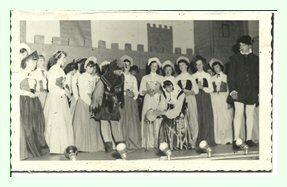 On invitation of principal W. Ferguson, Yarrow Junior High School, school trustee J.J. Wittenberg presented a trophy for public speaking at a student assembly held in the music room.
The cup, donated by J.J. Wittenberg Jewellery, a replica of the larger trophy to be presented at a later date, was won by Miss Miller in the school competition. The cup will be retained by the winner permanently, while the Alice larger trophy will be held by the winner for a year. In making the presentation, Mr. Wittenberg stressed the advantages of public speaking, stressing also the future need of public leaders and speakers.
Newspaper Article Courtesy of Esther Harder
|
|
|
David Klassen - The Chilliwack Progress - April 20, 1955
Very Healthy Says David Klassen
Bee Sting Just Thing for Rheumatic Ills
Rheumatism been bad lately? Try 'a bee sting' for quick relief.
"It's the very thing," says David Klassen, Yarrow, a man with bees in more than his bonnet. "Very Healthy."
Mr. Klassen was taking delivery of his annual 25 colonies of honey bees. Local express office trundled them out to his car with no delays. They were restless after a long trip
from California.
Sound small - 25 colonies? It is except there are 15,00 little warriors in each colony. This was roughly a bee city the size of Vancouver sitting in front of the Post Office.
Mrs. Klassen belongs to the adventurous profession known as bee-keeping. Each year about this time he replenishes his stock for the summer honey season.
ROOMS FOR ALL
Mr. Klassen anticipates no housing shortage among his visitors. When the queen be in each colony of 15,000 starts raising the population by laying eggs,
he adds another hive. If the birth rate keeps going up he adds further hives until there are five or six.
B.C. bee-keepers don't breed bees for sale - in fact breeding stock can't be bought in Canada so Mr. Klassen has to send to California for them.
Each family of honey producers arrives in its own bungalow about a foot square. The 15,00 workers inhabit the single room. Madame Queen has a separate compartment reserved for
her. The rest of the family would kill her if she mixed with them.
"They get restless when travelling," says Mr. Klassen.
The bees don't get hungry. A small can on the floor contains a cloth wick saturated in syrup. Bees like syrup.
DONNED VEIL
Mr. Klassen donned the veil and smoker symbols of bee-keeping at Coaldale, Alberta in 1924. He worked with a man who owned 1700 colonies - 15,000 residents in each.
Honey season lasts from July until September. Mr. Klassen keeps two colonies and sells the rest to other local bee-men. His own bees produce about 400 pounds of honey each summer.
He makes two collections, one at the start of the season and one at the end.
"They get lazy in the summer," he says. "I take the honey away and it makes them work."
After September he kills all his stock. It takes 40 pounds of honey to feed them during the winter and they do not produce during this time. Mr. Klassen says it just doesn't pay.
The bees aren't expensive. A whole family can be bought for $5.
B.C. BEST
Here's advice from a bee-keeper to a honey-eating public - B.C. honey is the best.
Mr. Klassen claims the great profusion of flowering plants here is the main reason for the better quality. Bulk of local honey is from clover. It is very clear.
"But there is no such thing as pure honey," he says. "You can't stop a bee from landing on a raspberry bush." Raspberry honey is good too ... Mr. Klassen revealed.
B.C. Honey won first prize at a London exhibition several years ago, Mr. Klassen said.
The bee-keeper likes his bees and he's not afraid of getting stung.
DON'T JAB
"Don't bother them and they won't bother you!" is his advice. "You jab them though and they'll jab back. "
Mr. Klassen and his bees did not linger long in front of the post office. He wanted to get them settled. They don't go into the hives until evening however,
bright sunshine and spring mean flowers and the bees start roaming.
One member of Mr. Klassen's bee family must have been a little sad, however, when the cavalcade departed. He was noticed buzzing around one of The Progress
windows trying to get in.
The little fellow got left behind ...
Newspaper Article Courtesy of Esther Harder
|
|
| | It Was A Time |
|---|
|
It was a time when
as the Sumas lake bottom dried
the small, independent Mennonite farmers
with a few acres in raspberries, strawberries
and beans — cash crops two or less
years after planting — a few apple, cherry,
plum and pear trees, and of course a kitchen
garden — fresh fruit and vegetables
for eating and canning — a chicken barn,
half a dozen cows and enough pasture
for grazing and winter hay, two or three pigs
in the pen, farmers with hard work, piety, and order
who processed and marketed produce through
the Co-op and a day-job on the side flourished
gratefully for a good and successful life,
but guilt ridden for brothers and sisters
in the former Black Sea colonies, dispossessed,
murdered, dispersed, enslaved in Siberian work
camps, drafted into the Red Army, killed, captured,
repatriated to Germany, drafted into the Wehrmacht,
killed, captured, starved families decimated,
and maybe sponsored as immigrants to Canada.
It was a time when
the small, independent Mennonite farmers
who sold their farms to those displaced persons
and soldiers from the Vedder army base all flourished
in Clearbrook, Langley, Vancouver, the Okanagan,
Kitimat, and even in Winkler, Winnipeg and California.
© by Elmer Wiens
|
|


